AI Agent Interoperability: China's 7 National Standards Deep Dive
On June 26, 2026, China’s State Administration for Market Regulation released 7 national standards for AI Agent Interoperability, covering reference architecture, identity codes, identity management, agent description, agent discovery, agent interaction, and tool calling. This is China’s first closed-loop standard system for multi-agent collaboration.
1. Introduction: When Agents Start “Talking”
The explosive growth of large language models has evolved AI from “Q&A tools” to “autonomous execution systems”—this is the AI Agent. But before 2026, agents from different companies were like “isolated islands”: Huawei’s agents couldn’t call Alibaba’s tools, ByteDance’s agents had no unified “language” to interact with Tencent’s.
This fragmentation severely constrained the development of multi-agent collaboration. Building cross-vendor agent systems required custom development for each integration—costly, time-consuming, and hard to scale.
The 7 national standards released on June 26, 2026, address precisely this pain point. The standard system covers the full chain: identity identification → capability description → supply-demand discovery → collaborative interaction → tool invocation.
2. The 7 Standards Breakdown
2.1 Standard Architecture
┌──────────────────────────────────────────────────────┐
│    AI Agent Interoperability — 7 National Standards   │
├──────────┬──────────┬──────────┬──────────┬──────────┤
│Reference │ Identity │Capability│Interaction│  Tools   │
│Architecture│ System │  Layer   │   Layer  │  Layer   │
├──────────┴──────────┴──────────┴──────────┴──────────┤
│         ⑦ Agent Discovery (Directory & Registry)     │
└──────────────────────────────────────────────────────┘
Standard 1: Reference Architecture Defines a universal layered architecture: Perception → Decision → Execution → Collaboration. Specifies interface specifications and data flow formats between layers.
Standards 2/3: Identity Code & Identity Management Each agent receives a unique Agent ID (AID) with full lifecycle management (registration → authentication → authorization → deactivation). AIDs are compatible with China’s Unified Social Credit Code system.
Standard 4: Agent Description Defines the Agent Capability Description Language (ACDL) using JSON Schema format to describe agent functions, inputs/outputs, and invocation constraints.
Standard 5: Agent Discovery Defines registration and discovery protocols supporting both “publish-subscribe” and “query-response” modes.
Standard 6: Agent Interaction Defines inter-agent communication protocol (gRPC+Protobuf), supporting synchronous calls, async messaging, and event subscription. Introduces the interaction context concept with complete traceability chain.
Standard 7: Tool Calling Defines standard protocols for agent-external API/tool invocation, unifying registration, parameter mapping, authentication, and result return.
3. Technical Implementation
// Agent Registry Service implementing the national standards
package main

import (
    "crypto/ed25519"
    "encoding/hex"
    "encoding/json"
    "fmt"
    "sync"
    "time"
)

type AgentID struct {
    Prefix    string `json:"prefix"`
    OrgID     string `json:"org_id"`
    AgentType string `json:"agent_type"`
    Serial    string `json:"serial"`
}

type Capability struct {
    ID          string          `json:"id"`
    Name        string          `json:"name"`
    Description string          `json:"description"`
    Input       json.RawMessage `json:"input"`
    Output      json.RawMessage `json:"output"`
    Constraints map[string]any  `json:"constraints,omitempty"`
}

type AgentManifest struct {
    AID            AgentID      `json:"aid"`
    Name           string       `json:"name"`
    Version        string       `json:"version"`
    Capabilities   []Capability `json:"capabilities"`
    AuthEndpoint   string       `json:"auth_endpoint"`
    ServiceAddr    string       `json:"service_addr"`
    Signature      string       `json:"signature"`
    RegisteredAt   time.Time    `json:"registered_at"`
    HeartbeatAt    time.Time    `json:"heartbeat_at"`
}

type Registry struct {
    mu      sync.RWMutex
    agents  map[string]*AgentManifest
    pubKey  ed25519.PublicKey
    privKey ed25519.PrivateKey
}

func NewRegistry() *Registry {
    pub, priv, _ := ed25519.GenerateKey(nil)
    return &Registry{
        agents:  make(map[string]*AgentManifest),
        pubKey:  pub,
        privKey: priv,
    }
}

func (r *Registry) Register(manifest *AgentManifest) error {
    r.mu.Lock()
    defer r.mu.Unlock()

    aid := manifest.AID.String()
    sig, _ := hex.DecodeString(manifest.Signature)
    data, _ := json.Marshal(manifest.AID)
    if !ed25519.Verify(r.pubKey, data, sig) {
        return fmt.Errorf("signature verification failed")
    }

    manifest.RegisteredAt = time.Now()
    manifest.HeartbeatAt = time.Now()
    r.agents[aid] = manifest
    return nil
}

func (r *Registry) DiscoverByCapability(capID string, limit int) []*AgentManifest {
    r.mu.RLock()
    defer r.mu.RUnlock()

    var results []*AgentManifest
    for _, agent := range r.agents {
        for _, cap := range agent.Capabilities {
            if cap.ID == capID {
                results = append(results, agent)
                break
            }
        }
        if len(results) >= limit {
            break
        }
    }
    return results
}
4. Industry Impact
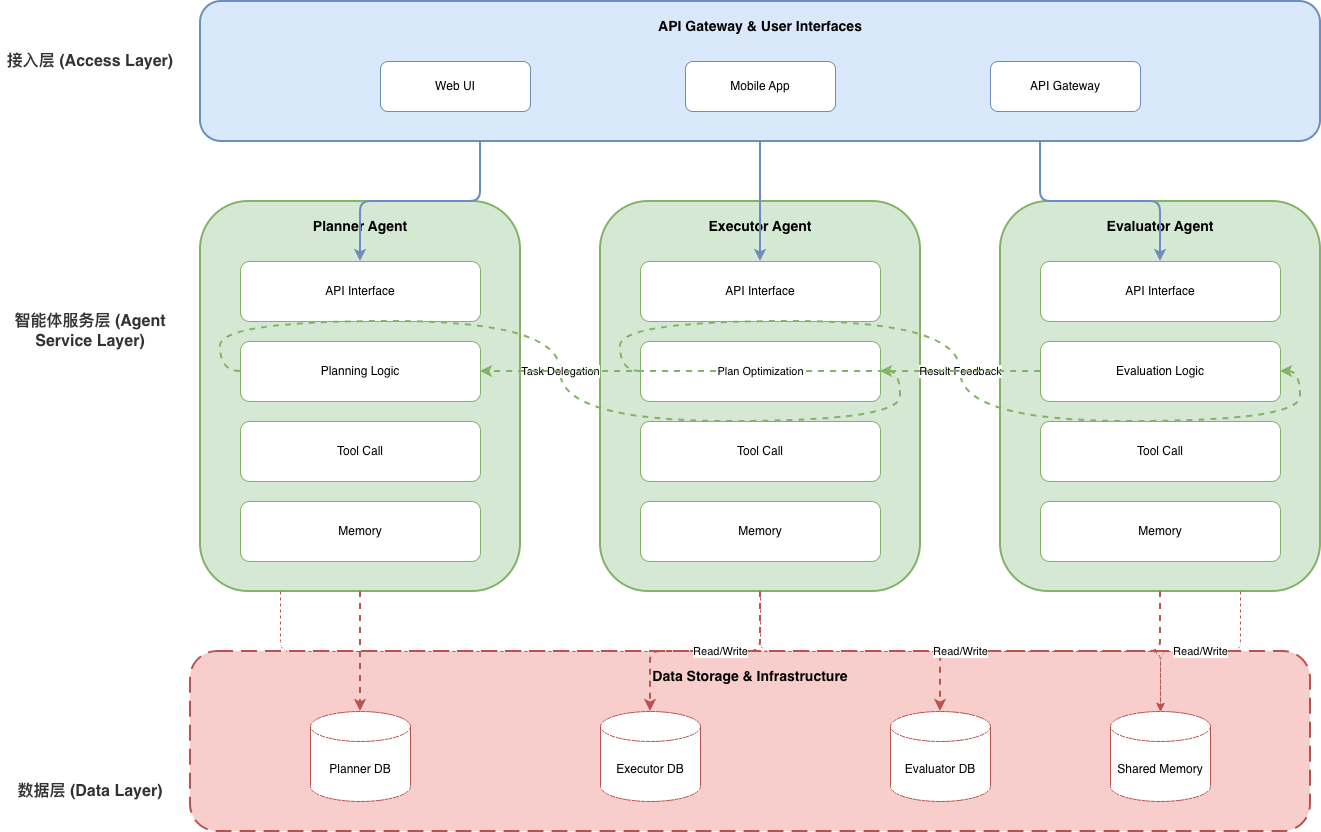
For large enterprises: Standardization reduces multi-agent system development costs by 50-70%.
For SMBs: Standard components eliminate the need to build agent systems from scratch. Compliance barriers for government procurement are removed.
For government clients: Unified identity authentication + full traceability solves the compliance challenge of “who is responsible when an agent makes a mistake.”
5. Comparison with Global Standards
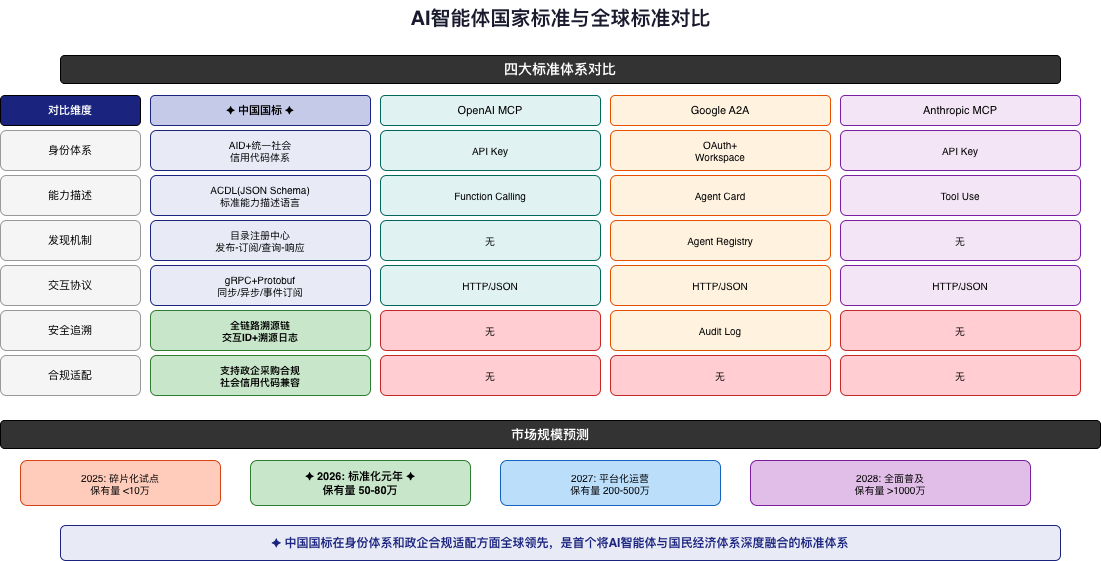
| Dimension | China National Std | OpenAI MCP | Google A2A | Anthropic MCP |
|---|---|---|---|---|
| Identity | AID+Org Credit Code | API Key | OAuth+Workspace | API Key |
| Capability | ACDL (JSON Schema) | Function Calling | Agent Card | Tool Use |
| Discovery | Registry+Query | None | Agent Registry | None |
| Protocol | gRPC+Protobuf | HTTP/JSON | HTTP/JSON | HTTP/JSON |
| Traceability | Full chain trace | None | Audit Log | None |
China’s standards uniquely integrate identity systems with government procurement compliance—AID compatibility with social credit codes and full-chain traceability mechanisms.
6. Summary
The 7 national standards for AI Agent Interoperability solve three core problems:
- Interoperability: Unified architecture and protocols enable cross-vendor agent communication
- Trust: Unified identity authentication and traceability mechanisms build confidence
- Scalability: Standard components lower barriers for SMBs to enter the agent ecosystem
From “isolated islands” to “interconnected ecosystems,” the AI agent industry is undergoing a qualitative transformation. 2026 marks the “standardization元年” of China’s AI agent industry.
Sources: China releases 7 national standards for AI Agent Interoperability - Xinhua