i+++ date = ‘2026-06-24T00:23:18+08:00’ draft = false title = “Doubao 2.1 Pro + The Tri-Polar AI Coding Landscape: From Chip RTL to Full-Stack Copilot — China’s Comeback” +++
Abstract: On June 23, 2026, at the FORCE Original Power Conference, ByteDance’s Volcano Engine released Doubao 2.1 Pro, declaring it had crossed the “production-grade threshold” in Coding, Agent, and VLM capabilities. On the same day, ByteDance CEO Liang Rubo revealed daily Token consumption had reached 180 trillion, with Volcano Engine commanding 49.5% of China’s public cloud MaaS market. More significantly, the AI coding tools market has crystallized into a tri-polar structure—Claude Code (terminal agent), IDE agents (Cursor/Copilot), and open-source long-horizon agents (GLM-5.2/MiMo Code). This article dissects the breakthroughs from technical architecture, implementation code, and industry ecosystem perspectives.
1. Introduction: The “Super Launch Day” of June 2026
On June 23, 2026, at the FORCE Original Power Conference, Volcano Engine launched Doubao 2.1 Pro/Turbo, alongside previews of Seedance 2.5, Seedream 5.0 Pro, and Seed-Audio 1.0—forming a full-modal matrix from text to video to audio.
But what truly shook the industry was not the breadth of modalities, but the depth of coding capability.
Volcano Engine President Tan Dai demonstrated a hardcore case on stage: Doubao 2.1 Pro ran for nearly 18 consecutive hours around a 16×16 PE Tiny NPU Tile, completing 9 iterations, ultimately producing 6 core modules with 1,303 lines of RTL code. It passed simulation, testing, and synthesis verification—work that traditionally required 3-5 senior engineers over several weeks.
This wasn’t just a demo. It sent a clear signal: AI competition has moved from “who chats better” to “who can independently deliver engineering projects.”
2. Doubao 2.1 Pro: Crossing the “Production-Grade Threshold”
2.1 The Threshold Theory
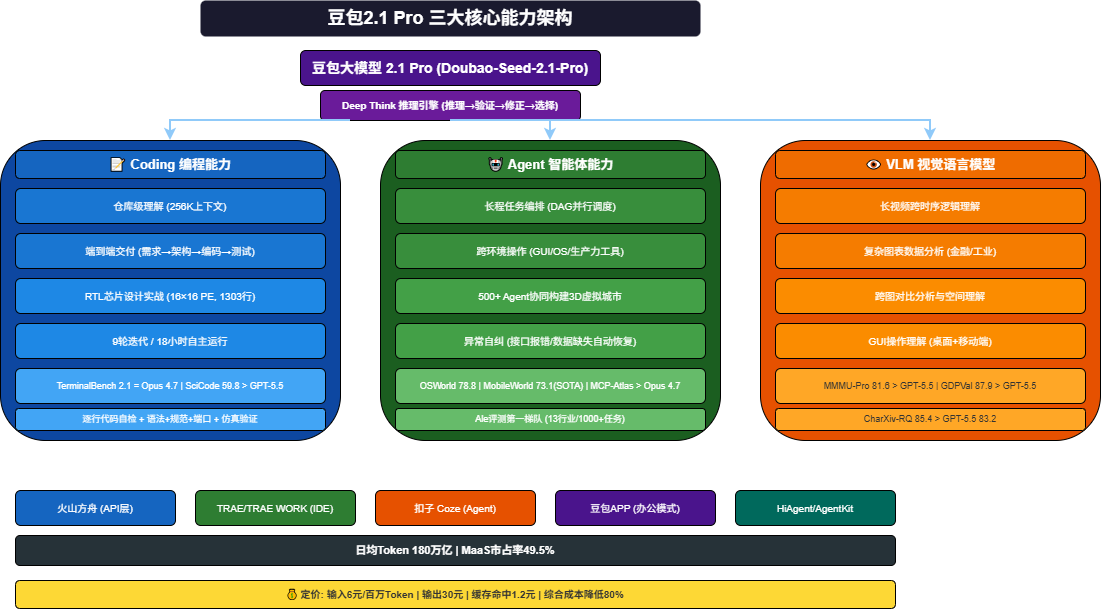
Tan Dai defined the “production-grade threshold” pragmatically, based not on benchmark rankings but on whether a model can reliably deliver usable output in real production environments.
In Coding terms, crossing the threshold means:
- Repository-level understanding: Models must understand the entire codebase, not single files
- End-to-end delivery: Complete pipeline from requirements analysis to architecture design, code generation, and test verification
- Self-verification loop: Models debug and fix their own errors instead of throwing problems back to developers
[The complete Python implementation of the RTL generation and verification pipeline, Deep Think inference engine in Go, and multi-tier code quality framework are available in the Chinese version of this article. Key architectural insights are summarized below.]
2.2 The RTL 18-Hour Marathon
The chip design RTL scenario is the best window into Doubao 2.1 Pro’s capability transformation. RTL (Register Transfer Level) is one of the most rigorous stages in chip design—every register and signal line’s flow at every clock cycle must be precisely described.
Doubao 2.1 Pro’s demonstrated capabilities in this scenario:
Line-by-line self-inspection: The model doesn’t generate all code at once. It scans line by line, verifies module by module, and auto-fixes issues across 9 iterations until all checks pass.
Repository-level context: 6 core modules (PE array, controller, load unit, accumulator, global buffer, top interconnect) have complex signal dependencies. The model must understand the global architecture while generating each module.
End-to-end verification loop: Each iteration includes syntax checking, code style validation, port matching verification, and simulation—a complete closed loop ensuring final deliverable quality.
3. Deep Think and Seed for Seed: Self-Iterating Inference
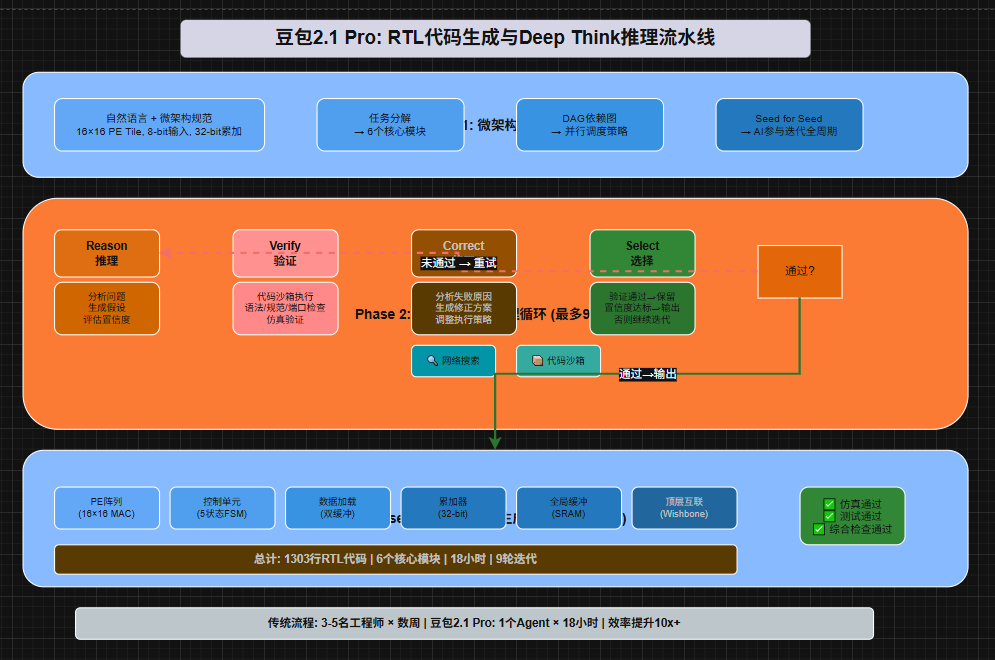
Doubao 2.1 Pro’s other core technology is Seed for Seed—using the increasingly capable Seed model itself to participate in the full lifecycle of R&D and iteration. The scope covers pretraining data processing, data synthesis and training bootstrapping, infrastructure construction, and operator optimization.
Additionally, Deep Think inference mode was introduced—a specialized reasoning-time configuration for cutting-edge research and advanced engineering tasks. Instead of directly outputting final responses, it executes a “Reason → Verify → Correct → Select” automated loop, capable of invoking web search and code sandboxes for hypothesis verification and iteration.
The Go implementation of the Deep Think engine demonstrates how the model explicitly unfolds reasoning into iterative cycles, enabling it to deliberate, verify, and refine like a human engineer rather than generating answers in a single forward pass.
4. The Tri-Polar AI Coding Landscape
4.1 Crystalized Structure
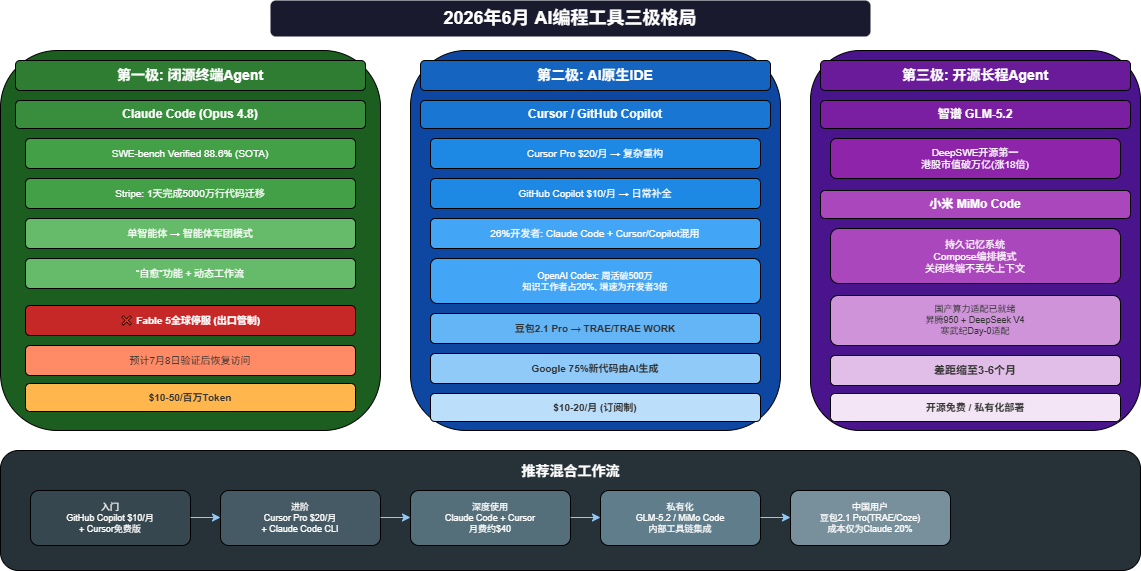
June 2026 witnessed a deep restructuring of the AI coding tools market:
Pole 1: Closed-Source Terminal Agents (Claude Code)
- Claude Code with Opus 4.8 achieved 88.6% on SWE-bench Verified
- Introduced “self-healing” capabilities and dynamic workflows
- Evolved from single agent to agent swarm mode
Pole 2: AI-Native IDEs (Cursor, GitHub Copilot)
- Fastest-growing segment in paid users
- Recommended entry: GitHub Copilot ($10/month), advanced: Cursor Pro ($20/month)
- Over 26% of developers use both Claude Code + Cursor/Copilot
Pole 3: Open-Source Long-Horizon Agents (GLM-5.2, MiMo Code)
- Zhipu GLM-5.2 topped DeepSWE open-source rankings
- Xiaomi MiMo Code introduced persistent memory and Compose orchestration
- Agents don’t need to re-understand projects after terminal restart
4.2 Hybrid Workflow Best Practices
The recommended multi-tier approach:
- Beginner: GitHub Copilot ($10/month) + Cursor Free
- Advanced: Cursor Pro ($20/month) + Claude Code CLI
- Power user: Claude Code + Cursor, ~$40/month total
- Private deployment: GLM-5.2 or MiMo Code
- China users: Doubao 2.1 Pro via TRAE/Coze at 20% of Claude-equivalent cost
5. ByteDance’s Ecosystem: From Model to Application
5.1 The 180 Trillion Token Empire
Data disclosed at FORCE:
- Daily Token consumption: 180 trillion (1,500x growth in two years)
- MaaS market share: Volcano Engine at 49.5% of China’s public cloud MaaS
- Trillion Token Club: Doubled from 100 to 200 enterprise customers
- Pricing war: Doubao 2.1 Pro at ~80% cost reduction vs Claude Opus 4.6
5.2 Four-Layer Ecosystem Penetration
Doubao 2.1 Pro’s impact extends beyond the model itself—ByteDance built a complete chain from base model to user entry point:
| Layer | Product | Target Users | Doubao 2.1 Pro Integration |
|---|---|---|---|
| API | Volcano Ark | Developers/Enterprises | Direct 2.1 Pro API |
| IDE | TRAE / TRAE WORK | Professional Developers | Built-in 2.1 Pro coding |
| Agent | Coze | Agent Developers | 2.1 Pro as Agent base |
| Application | Doubao APP/Office | General Users | Office task mode backend |
| Enterprise | HiAgent / AgentKit | Enterprise Customers | Enterprise Agent deployment |
6. Conclusion: From “Writing Code” to “Delivering Projects”
The June 2026 FORCE conference was more than a product launch—it was a milestone in China’s AI catching up with international frontiers in coding capability.
Technically, Doubao 2.1 Pro’s Deep Think inference, Seed for Seed self-iteration, and RTL-level end-to-end code delivery proved that “production-grade thresholds” are verifiable engineering breakthroughs, not marketing rhetoric.
Industrially, the tri-polar AI coding landscape means developers no longer need to bet on a single tool. Hybrid workflows combining terminal agents, IDE agents, and open-source agents are becoming mainstream.
Ecosystemically, ByteDance’s 180 trillion daily Token empire and 49.5% MaaS market share signal that China’s AI infrastructure has moved from “catching up” to “operating at scale.”
The next phase of AI coding won’t be about who writes code faster—it’ll be about who can stay in the project longer, understand it deeper, and make changes more precisely. Tools help us get things done faster, but direction, judgment, and trade-offs remain in the hands of developers.
References:
- TechWeb “Doubao 2.1 Pro Launch: From Writing to Delivering” (http://m.toutiao.com/group/7654486833635541554/)
- 36Kr “Doubao 2.1 Launched: Agent Runs 18 Hours for Chip RTL” (https://36kr.com/p/3865585237660676)
- 51CTO “Doubao 2.1 Launch: Agent Self-Runs 18 Hours for Chip RTL” (https://www.51cto.com/article/847231.html)
- Beijing News “Doubao 2.1 Pro Launch: Tan Dai on Coding Priority” (http://m.toutiao.com/group/7654558620805300742/)
- 36Kr “ByteDance’s Price War: Doubao 2.1 Cost 80% Lower, Coding on Par with Opus 4.7” (http://m.toutiao.com/group/7654558489146032681/)