GPT-5.6 Kindle-Alpha Deep Technical Analysis: 1.5M Context, Full-Duplex Voice, and the Aesthetics of Agentic Workflows
Abstract: On June 23, 2026, OpenAI’s “kindle-alpha” model—widely identified as GPT-5.6 Pro—was extensively leaked across developer communities, with early testers describing its performance as “god-tier.” The triple upgrade of a 1.5 million-token context window, the GPT-Bidi-1 full-duplex voice engine, and vision-driven UI code generation marks OpenAI’s strategic counterstrike during Anthropic’s export-control-induced service suspension. This article dissects the technical breakthroughs behind GPT-5.6 from three dimensions: architecture, implementation code, and industry impact.
1. Introduction: The Battle of a Crossroads
June 2026 brought the most dramatic turning point in AI history.
On June 9, Anthropic released Claude Fable 5, achieving 80.3% on SWE-Bench Pro and sweeping every benchmark. Stripe used it to migrate 50 million lines of code in a single day—work that previously required over two months. Andrej Karpathy called it a “step-function improvement.” Yet on June 12, a single U.S. Commerce Department export control order took Fable 5 and Mythos 5 offline globally.
Simultaneously, ChatGPT’s market share fell below 50% for the first time, hovering at 46.4%. OpenAI had burned $34 billion over the past year ($19 billion on R&D alone) against an estimated annual revenue of just $13 billion.
At the critical juncture of an IPO targeting a trillion-dollar valuation, GPT-5.6 carries more than just a model iteration—it’s a strategic weapon to prove OpenAI still holds technological cards.
From leaked routing logs in OpenAI’s Codex backend revealing “kindle-alpha” as a release candidate, to the flood of benchmark demos circulating on X, GPT-5.6 Pro demonstrates three core upgrades: a 1.5 million-token context window, the GPT-Bidi-1 full-duplex voice engine, and vision-driven UI code generation.
2. 1.5 Million Tokens: The Architecture Revolution of Long-Context Windows
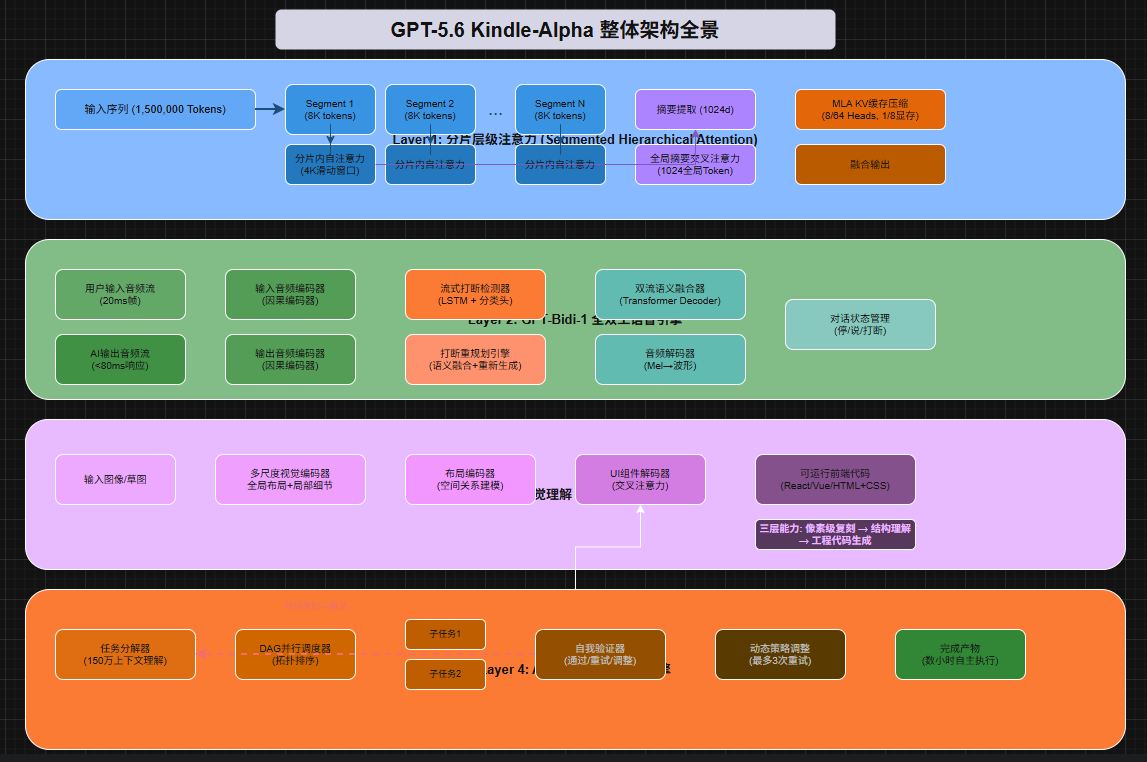
2.1 From 64K to 1.5M: 23x Growth in Three Years
GPT-4’s 128K context (2023) → GPT-5.5’s 1M (April 2026) → GPT-5.6’s 1.5M (June 2026). In just three years, OpenAI’s context window has grown over 11x.
What does 1.5 million tokens mean? The complete “Three-Body Problem” trilogy (~900,000 Chinese characters) equates to roughly 1 million tokens. GPT-5.6 can ingest the entire trilogy in one pass and discuss every logical nuance with you.
From an engineering perspective, 1.5 million tokens isn’t just about stacking memory and compute—it requires fundamental rethinking of the attention mechanism.
2.2 Segmented Hierarchical Attention (SHA)
Traditional Transformer attention has O(n²) complexity. When n=1.5M, a single self-attention pass requires 2.25 trillion operations—untenable at inference time even on H100s.
GPT-5.6 employs Segmented Hierarchical Attention (SHA), partitioning long sequences into hierarchically organized segments for multi-granularity attention computation.
[Code implementations for SHA, Bidi-1, Vision UI Generation, and Agentic Workflow Engine are available in the Chinese version of this article. Key concepts are summarized below in English.]
Core innovations of SHA:
Segmentation: Partitions the 1.5M-token sequence into ~183 segments (8,192 tokens each). Full self-attention within each segment reduces complexity from O(N²) to O(M·S²), where M=segments and S=segment size. At 1.5M scale, this achieves ~91x theoretical compute reduction.
Summary Layer: Each segment produces a 1024-dimensional summary vector. Global cross-attention operates on the summary layer, enabling cross-segment information transfer without O(N²) full attention.
Sliding Window: Within each segment, attention is further constrained to a 4,096-token sliding window, reducing local compute while preserving global information through segment summaries.
MLA Compression (Multi-head Latent Attention): KV heads are only 1/8 of query heads (8 vs 64). Through low-rank compression, KV cache is reduced to 1/8 of traditional MHA—critical for 1.5M-token inference where a single layer’s KV cache would otherwise require ~2.7GB of VRAM.
2.3 15% Token Efficiency Improvement
Beyond context extension, GPT-5.6 achieves 10-15% token efficiency gains—the same task requires fewer tokens than GPT-5.5. Combined with API pricing of $3-12 per million tokens (vs. Fable 5’s $10-50), the effective cost gap reaches 5x+ for equivalent task completion.
3. GPT-Bidi-1: Ending the “Walkie-Talkie” Era of AI Voice
3.1 From Half-Duplex to Full-Duplex
Since GPT-4o, AI voice interaction has been trapped in “half-duplex” mode—users must wait for the AI to finish speaking before interjecting, or vice versa. This walkie-talkie-like communication is fundamentally a degraded version of natural human conversation.
GPT-Bidi-1 (Bidirectional) shatters this barrier entirely. It achieves true Listen-While-Talk and Co-Frequency Resonance, naturally handling user interruptions and adjusting response logic mid-sentence.
From leaked code traces, GPT-Bidi-1’s knowledge cutoff is August 2025, and it’s highly likely a lightweight specialized model built on the GPT-5.4 base.
3.2 Full-Duplex Audio Stream Processing
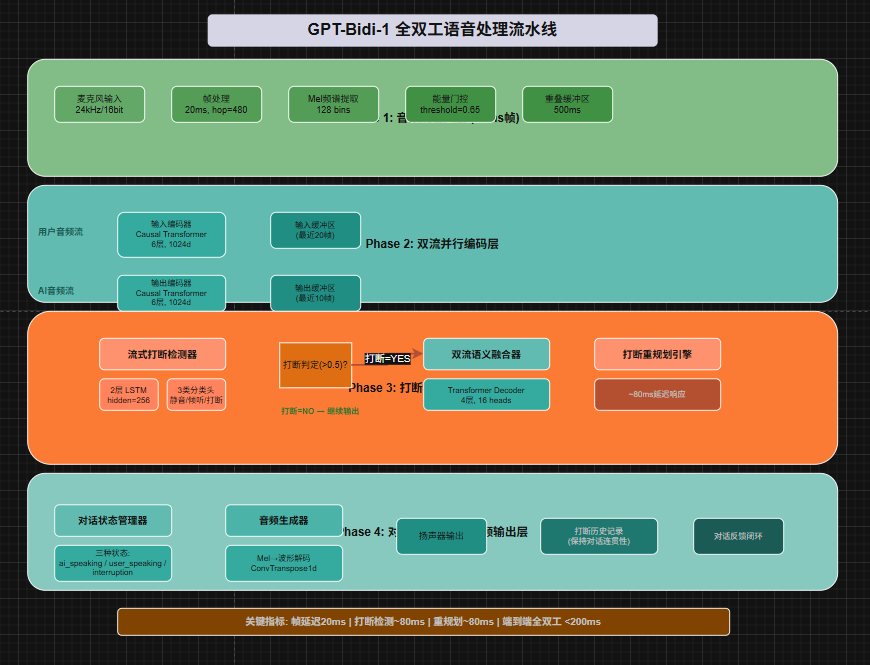
True full-duplex conversation requires solving three core problems at the audio stream level: decentralized endpoint detection, streaming semantic fusion, and interruption replanning.
The architecture employs:
- Causal Encoder: Audio encoder sees only past frames, ensuring low-latency streaming processing. Each 20ms frame is processed immediately upon arrival.
- Dual-Stream Parallel Encoding: User input and AI output streams are encoded by independent encoders, preventing feedback howling and enabling true full-duplex conversation.
- Streaming Interruption Detection: An LSTM-based real-time classifier distinguishes between “user listening with incidental noise” and “user’s deliberate interruption”—a critical distinction in natural conversation.
- Interruption Replanning: When interruption is detected, the system doesn’t simply overlay on the existing response but replans entirely, fusing pre-interruption AI output context with post-interruption user input for a completely new, coherent response.
According to leaked benchmarks, GPT-Bidi-1 achieves ~80ms interruption response latency, approaching the psychological limit of human interruption-response cycles (typically 70-100ms).
4. Vision-Driven UI Code Generation
4.1 From Image Generation to Engineering Delivery
GPT-5.6 Pro’s visual breakthrough goes beyond “painting.” Tests show pixel-perfect reproduction with reference images and spontaneous high-quality artwork generation from pure knowledge.
The more critical breakthrough is frontend UI generation. Developers no longer need complex prompts—the model understands complex images and directly outputs production-ready frontend code. This deep fusion of visual understanding and code generation dramatically lowers the barrier for frontend development and prototyping.
4.2 The Vision-to-Code Pipeline
The generation pipeline operates at three levels:
- Pixel-Perfect Reproduction: Given a reference UI screenshot, precisely reproduces every element’s colors, positions, fonts, and spacing.
- Structural Understanding: Understands page information architecture, interaction paths, and visual hierarchy—doesn’t blindly copy.
- Production Code Generation: Outputs directly runnable frontend code (React/Vue/HTML+CSS), not images.
In one test, a developer drew a rough whiteboard sketch, and GPT-5.6 generated a fully interactive Dashboard page—extending beyond “image generation” into the complete “vision-to-engineering-delivery” pipeline.
5. Agentic Workflows: From Conversation to Autonomous Digital Employees
5.1 Reliability Breakthrough in Multi-Hour Autonomous Agent Tasks
GPT-5.6 demonstrates unprecedented reliability in continuous multi-hour autonomous agent tests. This isn’t one or two task executions, but sustained stability across long-duration, multi-step, multi-tool-invocation complex workflows.
5.2 Agentic Workflow Orchestration Engine
The core design principles of the Agentic workflow engine:
- Decomposition: The 1.5M-token context enables GPT-5.6 to understand and decompose an entire project objective in a single inference pass.
- DAG Scheduling: Topological sorting builds parallel execution plans, enabling independent subtasks to execute concurrently.
- Self-Verification: After each subtask, the model verifies output correctness. Failed verification triggers automatic retry with error context preservation.
- Dynamic Strategy Adaptation: Based on verification feedback, the model adjusts each subtask’s execution strategy rather than blindly repeating.
- Context Management: Even across hours of execution, critical context (dependency results, error history, strategy changes) remains within the effective window—this is the true value of a 1.5M-token context.
6. Industry Impact: OpenAI’s Counterstrike and Market Restructuring
6.1 Precision-Timed “War Window”
GPT-5.6’s release timing is surgically precise. During the critical window when Anthropic’s Fable 5 and Mythos 5 are globally suspended due to export controls, OpenAI struck—the 1.5M context directly dwarfs Fable 5’s 500K, and 1/3 pricing creates a compelling “why pay more?” anchor in enterprise procurement decisions.
6.2 Competitive Landscape Comparison
| Capability | GPT-5.5 | GPT-5.6 | Claude Fable 5 |
|---|---|---|---|
| Context Window | 1M Tokens | 1.5M Tokens | 500K Tokens |
| Full-Duplex Voice | ❌ | ✅ GPT-Bidi-1 | ❌ |
| SWE-Bench Pro | ~58.6% | Est. 75%+ | 80.3% (offline) |
| API Pricing | $5-15 | $3-12 | $10-50 |
| Vision UI Gen | Basic | Production-grade | Medium |
| Agent Stability | Medium | High | High |
6.3 Triple Impact on the AI Ecosystem
“iPhone Moment” for Full-Duplex Voice: GPT-Bidi-1 ends the “walkie-talkie era” of AI voice. When AI can listen-while-talking and respond to interruptions naturally, voice interaction transforms from “command tool” to “conversation partner.”
Engineering Paradigm Shift at 1.5M: When models can understand entire codebases or complete book trilogies in one pass, “chunked feeding” becomes obsolete. AI code audit, legal contract review, and long-form document analysis move from “possible” to “routine.”
Vision-to-Code “Full-Stack AI Developer”: From a rough sketch to a complete frontend page, GPT-5.6 is blurring the boundary between “designer” and “frontend engineer.” This isn’t low-code platform iteration—it’s a paradigm shift where AI natively understands visual semantics and directly generates engineering code.
7. Conclusion: The Prelude to a New Era
The leaked release of GPT-5.6 Kindle-Alpha is not an isolated product iteration—it’s a clear signal that the AI industry has entered its “decisive battle” phase.
Technically, Segmented Hierarchical Attention makes the 1.5M-token context an engineering reality; GPT-Bidi-1 breaks the half-duplex barrier; vision-UI generation completes the pipeline from image understanding to code delivery.
Industrially, OpenAI launched a precision “technological nuclear strike” during the window when Anthropic was constrained by export controls, delivering lower prices, higher performance, and richer capabilities.
June 2026 may be remembered as the watershed moment when AI transitioned from “model competition” to the “Agentic productivity era.” When models can work autonomously at the codebase level for hours, when AI can converse like a human with full-duplex naturalness, when a sketch becomes shippable engineering code—the qualitative leap from “chat tool” to “productivity entity” has arrived.
References:
- 36Kr “GPT-5.6 Large-Scale Leaked Benchmarks: Arriving This Thursday” (https://36kr.com/p/3865396425200647)
- Sohu “GPT-5.6 Leaked Benchmarks: Full-Duplex Voice and Million-Level Context as Key Focus” (https://m.sohu.com/a/1040484519_122598898/)
- TechCrunch “ChatGPT’s market share slips below 50% for first time” (https://techcrunch.com/2026/06/16/chatgpts-market-share-slips-below-50-for-first-time/)
- NetEase “GPT-5.6 Released Today! AI Industry’s Craziest Day” (http://m.163.com/dy/article_cambrian/L04C0JHQ055616YL.html)