豆包2.1 Pro + AI编程三极格局:从芯片RTL到全栈Copilot的国产逆袭
摘要:2026年6月23日,火山引擎发布豆包2.1 Pro,宣布在Coding、Agent、VLM三大方向跨越"生产级质变点"。同日,字节跳动CEO梁汝波披露豆包日均Token调用量突破180万亿、火山引擎MaaS市占率49.5%。更值得关注的是,AI编程工具市场已形成Claude Code、IDE Agent(Cursor/Copilot)和开源长程Agent(GLM-5.2/MiMo Code)三极格局,中国模型正在改写全球AI生态规则。本文从技术架构、代码实现和产业生态三个维度深度解析。
一、引言:2026年6月的"超级发布日"
2026年6月23日,火山引擎2026夏季FORCE原动力大会上,字节跳动一口气发布了豆包大模型2.1 Pro/Turbo、Seedance 2.5(预告)、Seedream 5.0 Pro和Seed-Audio 1.0,形成了从文本到视频到音频的全模态矩阵。
但真正让整个行业震撼的,不是多模态的广度,而是编程能力的深度。
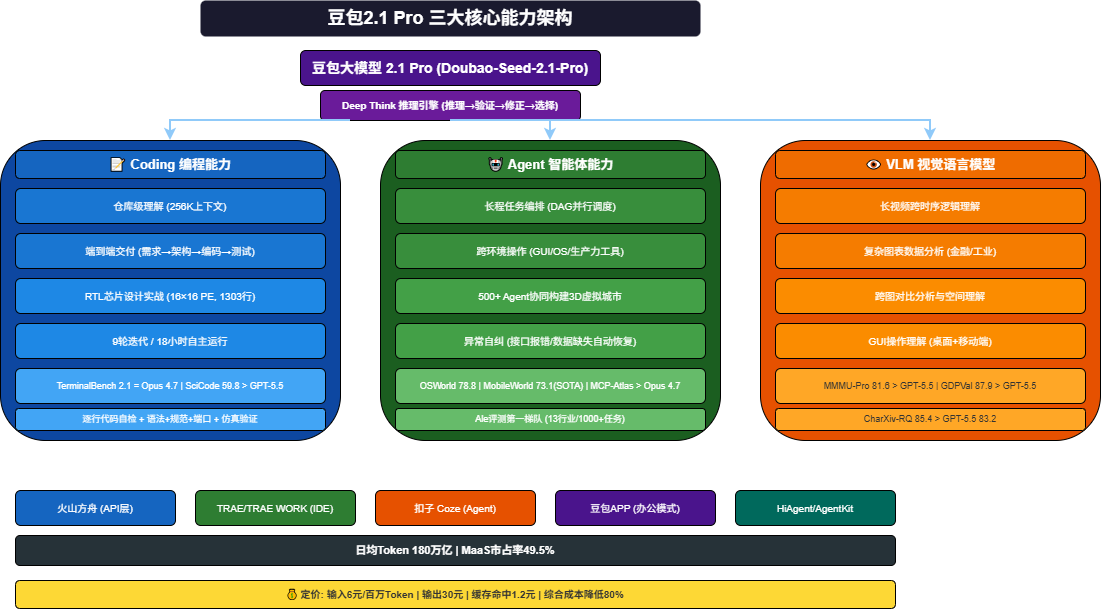
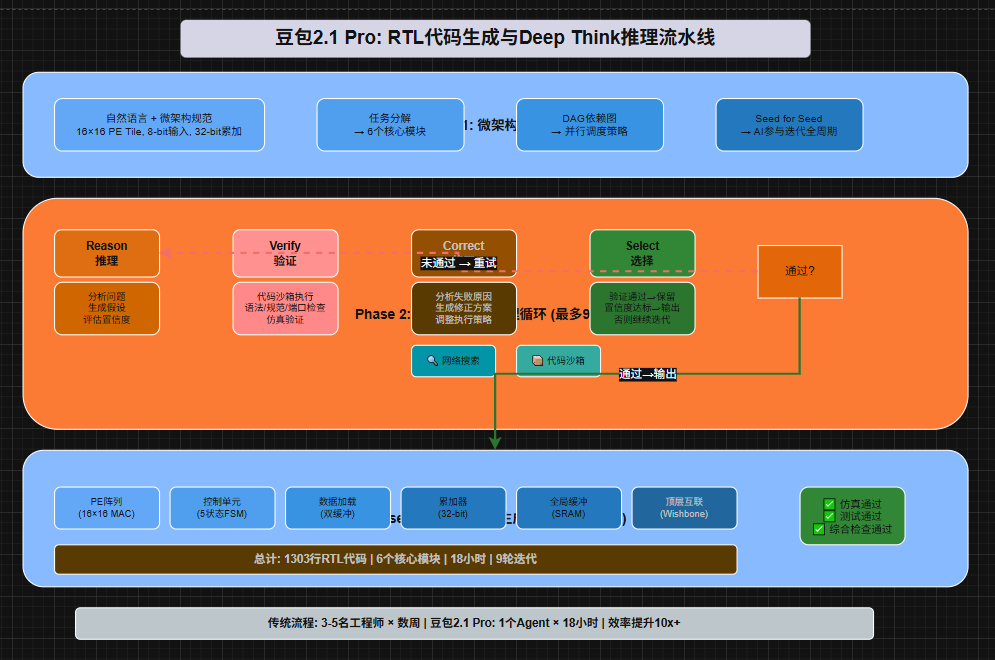
火山引擎总裁谭待在现场展示了一个硬核案例:豆包2.1 Pro围绕一个16×16 PE的Tiny NPU Tile,连续运行近18个小时,历经9轮迭代,最终完成了6个核心模块、1303行RTL代码,并跑通了仿真、测试和综合检查等完整工程流程——这类任务过去需要3-5名资深工程师数周才能完成。
这不仅仅是一次技术演示,它传递了一个明确的信号:大模型的竞争已经从"谁更会聊天"进入了"谁能独立交付工程项目"的新阶段。
与此同时,AI编程工具市场在2026年6月经历了一场深层洗牌。当前市场已形成清晰的三极格局:闭源终端Agent(Claude Code)、AI原生IDE(Cursor、GitHub Copilot)、开源长程Agent(GLM-5.2、MiMo Code)。Google已有75%的新代码由AI生成——这不是趋势预测,而是正在发生的事实。
二、豆包2.1 Pro:跨越"生产级质变点"
2.1 谭待的"质变点"理论
“只有当模型能力跨越质变点,才能真正满足企业与个人在生产场景中的使用需求。“火山引擎总裁谭待在FORCE大会上给出了一个务实的衡量标准。
从他给出的坐标系来看,全球范围内:
- 视频生成领域:Seedance 2.0 — 第一个也是目前唯一跨越质变点的模型
- Coding与Agent领域:Claude Opus 4.6 — 第一个跨越质变点的模型
- 最新成员:豆包2.1 Pro — 正式跨过生产级质变点
“质变点"的核心判断标准,不是榜单上的数字排名,而是模型能否在真实生产环境中稳定交付可用的产物。具体到Coding维度,这意味着:
- 仓库级理解:模型需要理解整个代码仓库,而不是单文件
- 端到端交付:从需求分析到架构设计、从代码生成到测试验证的完整链路
- 自测闭环:遇到报错自己能调试修复,而不是把烂摊子丢回给开发者
2.2 从能写到能交付:RTL芯片设计的18小时实战
豆包2.1 Pro在芯片设计RTL场景中的实战是理解其能力质变的最佳窗口。
RTL(Register Transfer Level,寄存器传输级)是芯片设计中最为严谨的环节之一。每个寄存器和信号线在每个时钟周期里的流动都需要精确描述。传统流程需要3-5名资深工程师花费数周时间才能完成一个中等规模的Tile设计。
"""
豆包2.1 Pro RTL代码生成与自主验证管线(架构重构)
基于公开演示资料的技术反推
"""

from dataclasses import dataclass, field
from typing import List, Dict, Optional, Tuple
import subprocess
import re
import time

@dataclass
class RTLModule:
    """RTL模块定义"""
    name: str
    ports: Dict[str, Tuple[int, str]]  # port_name -> (width, direction: input/output/inout)
    params: Dict[str, int]  # parameter -> value
    signals: List[str]  # internal signal declarations
    comb_logic: List[str]  # combinational logic blocks
    sequential: List[str]  # sequential (clocked) logic blocks
    assertions: List[str]  # formal assertions

    def to_verilog(self) -> str:
        """生成Verilog代码"""
        lines = []
        lines.append(f"module {self.name} #(")
        # Parameters
        param_lines = []
        for name, val in self.params.items():
            param_lines.append(f"    parameter {name} = {val}")
        lines.append(",\n".join(param_lines))
        lines.append(") (")
        # Ports
        port_lines = []
        for name, (width, direction) in self.ports.items():
            port_str = f"    {direction} "
            if width > 1:
                port_str += f"[{width-1}:0] "
            port_str += name
            port_lines.append(port_str)
        lines.append(",\n".join(port_lines))
        lines.append(");")

        # Signal declarations
        for sig in self.signals:
            lines.append(f"    {sig};")

        # Combinational logic
        for block in self.comb_logic:
            lines.append(block)

        # Sequential logic
        for block in self.sequential:
            lines.append(block)

        # Assertions
        for assert_stmt in self.assertions:
            lines.append(f"    {assert_stmt}")

        lines.append(f"endmodule\n")
        return "\n".join(lines)

class RTLGenerator:
    """
    RTL代码生成器 - 豆包2.1 Pro的核心代码生成组件
    从自然语言描述 + 微架构规范生成RTL代码
    """
    def __init__(self, model_generate_fn):
        self.model_generate = model_generate_fn
        self.generated_modules: Dict[str, RTLModule] = {}
        self.iteration_history: List[Dict] = []

    async def generate_tpu_tile(self, pe_size: int = 16) -> Dict[str, RTLModule]:
        """
        生成Tiny NPU Tile的完整RTL代码
        围绕PE阵列、控制逻辑、数据流、存储四大部分
        """
        modules = {}

        # 模块1: PE阵列 (Processing Element Array)
        pe_array = await self._generate_pe_array(pe_size)
        modules["pe_array"] = pe_array

        # 模块2: 控制单元 (Controller)
        controller = await self._generate_controller(pe_size)
        modules["controller"] = controller

        # 模块3: 数据加载单元 (Load Unit)
        load_unit = await self._generate_load_unit()
        modules["load_unit"] = load_unit

        # 模块4: 累加器单元 (Accumulator)
        accumulator = await self._generate_accumulator()
        modules["accumulator"] = accumulator

        # 模块5: 全局缓冲区 (Global Buffer)
        global_buf = await self._generate_global_buffer()
        modules["global_buffer"] = global_buf

        # 模块6: 顶层互联 (Top Interconnect)
        top = await self._generate_top_interconnect(modules, pe_size)
        modules["top"] = top

        self.generated_modules = modules
        return modules

    async def _generate_pe_array(self, size: int) -> RTLModule:
        """生成PE阵列"""
        pe_code = await self.model_generate(
            f"""Generate a {size}x{size} systolic PE array RTL in Verilog.

Specifications:
- Each PE performs MAC (multiply-accumulate) operation
- Data flows from left to right (weight stationary)
- Partial sums flow from top to bottom
- Bit width: 8-bit input, 32-bit accumulator
- Support chain for weight loading

Return COMPLETE synthesizable Verilog code with:
- module declaration with all ports
- internal signal declarations
- PE array instantiation using generate-for
- pipelining registers at each stage
- width parameters as module parameters"""
        )

        # Parse and construct RTLModule
        module = self._parse_verilog_to_module("pe_array", pe_code)
        return module

    async def _generate_controller(self, pe_size: int) -> RTLModule:
        """生成控制器"""
        ctrl_code = await self.model_generate(
            f"""Generate a control unit for a {pe_size}x{pe_size} systolic array RTL in Verilog.

Features:
- 5-stage state machine: IDLE, LOAD_WEIGHT, COMPUTE, ACCUMULATE, DRAIN
- Configurable loop bounds for different matrix sizes
- Stall generation for data dependency
- Control signals: weight_en, compute_en, drain_en, acc_clear
- Counter-based address generation for buffer access

Return complete synthesizable Verilog."""
        )
        return self._parse_verilog_to_module("controller", ctrl_code)

    async def self_verify_and_fix(self, module: RTLModule, iteration: int) -> RTLModule:
        """
        自我验证并修复RTL代码
        这是豆包2.1 Pro的核心能力——逐行代码检查
        """
        verilog_code = module.to_verilog()

        # 语法检查
        syntax_errors = self._check_syntax(verilog_code)

        # 代码规范检查
        style_issues = self._check_style(verilog_code)

        # 端口匹配检查
        port_errors = self._check_port_matching(verilog_code)

        errors = {
            "syntax": syntax_errors,
            "style": style_issues,
            "port": port_errors,
        }

        if any(errors.values()):
            # 让模型自动修复
            fix_prompt = f"""The following Verilog module has errors:

Module: {module.name}
Code:
```verilog
{verilog_code}
Errors Found: {syntax_errors} {style_issues} {port_errors}
Iteration: {iteration + 1}/9
Fix ALL errors and return the complete corrected module. Ensure the code is synthesizable.”””
        fixed_code = await self.model_generate(fix_prompt)
        fixed_module = self._parse_verilog_to_module(module.name, fixed_code)

        self.iteration_history.append({
            "iteration": iteration + 1,
            "module": module.name,
            "errors_found": errors,
            "fixed": True,
        })

        return fixed_module

    self.iteration_history.append({
        "iteration": iteration + 1,
        "module": module.name,
        "errors_found": errors,
        "fixed": False,
    })

    return module

def _check_syntax(self, code: str) -> List[str]:
    """Verilog语法检查"""
    errors = []

    # 检查begin/end配对
    begins = code.count("begin")
    ends = code.count("end")
    if begins != ends:
        errors.append(f"begin/end mismatch: {begins} begins vs {ends} ends")

    # 检查always块
    always_blocks = re.findall(r'always\s*@\s*\(', code)
    if not always_blocks:
        errors.append("No sequential logic (always blocks) found")

    # 检查端口声明
    if "input" not in code or "output" not in code:
        errors.append("Missing input/output port declarations")

    return errors

def _check_style(self, code: str) -> List[str]:
    """代码规范检查"""
    issues = []

    lines = code.split('\n')
    for i, line in enumerate(lines, 1):
        # 检查行长度
        if len(line) > 120:
            issues.append(f"Line {i}: exceeds 120 chars ({len(line)})")

        # 检查组合逻辑敏感列表
        if 'always @(*)' not in code and 'always_comb' not in code:
            if i > 1:  # 跳过module声明
                pass  # 有些风格使用always @(*)

    return issues

def _check_port_matching(self, code: str) -> List[str]:
    """端口匹配检查"""
    errors = []
    # 检查实例化中的端口连接
    inst_pattern = re.findall(r'(\w+)\s+#\(.*?\)\s+(\w+)\s*\(', code, re.DOTALL)
    if not inst_pattern:
        errors.append("No module instantiations found (check connectivity)")
    return errors
class RTLSimulator: """ RTL仿真验证器 - 豆包2.1 Pro的自主验证能力 """ def init(self): self.test_results = []
def run_simulation(self, rtl_code: str, testbench: str) -> Dict:
    """运行RTL仿真"""
    test_code = f"""{rtl_code}
`timescale 1ns/1ps {testbench} """ # 在实际环境中会调用iverilog/vcs等仿真器 # 这里模拟仿真流程
    compile_ok = "syntax" in rtl_code.lower()  # 简化检查
    if not compile_ok:
        return {"passed": False, "error": "Compilation failed", "log": "..."}

    return {"passed": True, "cycles": 100, "matches_expected": True}
async def run_rtl_workflow(): """ 完整的RTL开发工作流 模拟豆包2.1 Pro的18小时/9轮迭代流程 """ generator = RTLGenerator(lambda prompt: f"// Generated: {prompt[:50]}…") simulator = RTLSimulator()
all_passed = False
for iteration in range(9):
    print(f"Iteration {iteration + 1}/9")

    # 生成模块
    modules = await generator.generate_tpu_tile(16)

    # 验证每个模块
    for name, module in modules.items():
        module = await generator.self_verify_and_fix(module, iteration)

    # 顶层仿真
    top_code = modules["top"].to_verilog()
    result = simulator.run_simulation(top_code, "// testbench")

    if result["passed"]:
        all_passed = True
        print(f"✅ All {len(modules)} modules passed verification")
        break
    else:
        print(f"❌ Iteration {iteration + 1} failed: {result.get('error', 'unknown')}")

return all_passed, generator.iteration_history
豆包2.1 Pro在RTL生成中的关键能力体现在三个方面:
1. **逐行代码自检**:模型不会一次性生成所有代码然后交给用户,而是逐行扫描、逐模块验证。在9轮迭代中,每轮发现问题后自动修复,直到通过所有检查。
2. **仓库级上下文理解**:6个核心模块(PE阵列、控制单元、数据加载、累加器、全局缓冲、顶层互联)之间存在复杂的信号依赖。模型需要在生成每个模块时理解全局架构。
3. **端到端验证闭环**:每一轮迭代不仅包括代码生成,还包括语法检查、代码规范检查、端口匹配检查和仿真验证。完整的闭环确保了最终产物的可用性。
---
## 三、Seed for Seed:AI自我迭代的引擎
[](/images/blog/2026_06_24_doubao_2_1Pro_RTL_DeepThink.png)
豆包2.1 Pro的另一个核心技术是**Seed for Seed**机制——利用不断变强的Seed模型本身来深度参与研发和迭代的全生命周期。AI自我迭代的参与范围涵盖预训练数据的处理、数据合成与训练自举、基础设施建设与算子优化等。
此外,豆包2.1 Pro引入了**Deep Think**推理模式——一种专为前沿研究和高级工程任务设计的推理时配置。该模式不直接输出最终响应,而是执行"推理→验证→修正→选择"的自动化循环,期间可以调用网络搜索和代码沙盒进行假设验证与迭代。
```go
/*
* Deep Think推理模式引擎(Go实现)
* 豆包2.1 Pro的高级推理基础设施
*/
package main
import (
"context"
"fmt"
"log"
"sync"
"time"
)
// DeepThinkConfig 深度思考配置
type DeepThinkConfig struct {
MaxIterations int // 最大迭代次数
TimeoutPerStep time.Duration // 每步超时
VerifyEnabled bool // 是否启用验证
CodeSandboxURL string // 代码沙箱URL
SearchEnabled bool // 是否允许搜索
}
// DeepThinkEngine 深度思考引擎
type DeepThinkEngine struct {
config DeepThinkConfig
modelFn func(ctx context.Context, prompt string) (string, error)
verifyFn func(ctx context.Context, result string) (bool, string)
searchFn func(ctx context.Context, query string) (string, error)
sandboxFn func(ctx context.Context, code string) (string, error)
}
// ReasoningStep 推理步骤
type ReasoningStep struct {
Index int
Thought string
Hypothesis string
VerificationResult string
IsValid bool
Duration time.Duration
}
// DeepThinkResult 深度思考结果
type DeepThinkResult struct {
FinalAnswer string
Steps []ReasoningStep
TotalTime time.Duration
Confidence float64
}
func NewDeepThinkEngine(cfg DeepThinkConfig) *DeepThinkEngine {
return &DeepThinkEngine{
config: cfg,
}
}
// Solve 执行深度思考推理
func (e *DeepThinkEngine) Solve(ctx context.Context, problem string) (*DeepThinkResult, error) {
start := time.Now()
result := &DeepThinkResult{}
currentProblem := problem
var bestHypothesis string
var bestConfidence float64
for i := 0; i < e.config.MaxIterations; i++ {
select {
case <-ctx.Done():
return result, ctx.Err()
default:
}
stepStart := time.Now()
// Phase 1: 推理 (Reason)
thought, err := e.modelFn(ctx, fmt.Sprintf(
`Problem: %s
Iteration: %d/%d
Previous attempts: %d
Current best confidence: %.2f
Think step by step about this problem.
1) What approaches have been tried?
2) What's wrong with previous attempts?
3) What new approach should we try?
4) Form a specific hypothesis to verify.
Output format:
THOUGHT: <your reasoning>
HYPOTHESIS: <specific testable hypothesis>
CONFIDENCE: <0.0-1.0>`,
currentProblem, i+1, e.config.MaxIterations, i, bestConfidence,
))
if err != nil {
return nil, fmt.Errorf("reasoning failed: %w", err)
}
step := ReasoningStep{
Index: i,
Thought: thought,
Duration: time.Since(stepStart),
}
// Phase 2: 验证 (Verify)
if e.config.VerifyEnabled {
// 代码沙箱执行验证
if e.config.CodeSandboxURL != "" {
sandboxResult, err := e.sandboxFn(ctx, fmt.Sprintf(
`# Test hypothesis
import sys
hypothesis = """%s"""
def verify():
try:
# Execute verification logic
result = eval(hypothesis)
return True, str(result)
except Exception as e:
return False, str(e)
success, details = verify()
print(f"VERIFY_RESULT: {'PASS' if success else 'FAIL'}")
print(f"DETAILS: {details}")
`,
thought,
))
if err == nil {
step.VerificationResult = sandboxResult
step.IsValid = sandboxResult[:4] == "PASS"
}
}
// 模型自验证
validEval, feedback, err := e.selfEvaluate(ctx, thought)
if err == nil {
step.IsValid = step.IsValid || validEval
if !validEval {
step.VerificationResult += fmt.Sprintf("\nModel feedback: %s", feedback)
}
}
}
// Phase 3: 修正 (Correct) - 如果验证失败
if !step.IsValid && i < e.config.MaxIterations-1 {
correction, err := e.modelFn(ctx, fmt.Sprintf(
`The hypothesis failed verification.
Original problem: %s
Hypothesis: %s
Failure details: %s
Analyze WHY it failed and propose a CORRECTED hypothesis.
Be specific about what went wrong.`,
currentProblem, thought, step.VerificationResult,
))
if err == nil {
step.Thought += "\n\nCORRECTION: " + correction
}
}
// Track best
confidence := extractConfidence(thought)
if confidence > bestConfidence {
bestConfidence = confidence
bestHypothesis = extractHypothesis(thought)
}
result.Steps = append(result.Steps, step)
// Early exit if confidence is high enough
if bestConfidence > 0.95 {
break
}
}
result.FinalAnswer = bestHypothesis
result.TotalTime = time.Since(start)
result.Confidence = bestConfidence
return result, nil
}
// selfEvaluate 模型自我评估
func (e *DeepThinkEngine) selfEvaluate(ctx context.Context, thought string) (bool, string, error) {
eval, err := e.modelFn(ctx, fmt.Sprintf(
`Evaluate the following reasoning for correctness:
%s
Check for:
1. Logical consistency
2. Factual accuracy
3. Completeness
4. Missing edge cases
Output: VALID/INVALID + explanation`,
thought,
))
if err != nil {
return false, "", err
}
isValid := len(eval) > 0 && eval[:5] == "VALID"
return isValid, eval, nil
}
// MultiAgentSolver 多Agent协同求解器
type MultiAgentSolver struct {
agents []*DeepThinkEngine
mu sync.Mutex
}
func NewMultiAgentSolver(engines []*DeepThinkEngine) *MultiAgentSolver {
return &MultiAgentSolver{
agents: engines,
}
}
// SolveParallel 并行求解,投票选出最佳答案
func (s *MultiAgentSolver) SolveParallel(ctx context.Context, problem string) (*DeepThinkResult, error) {
type agentResult struct {
index int
result *DeepThinkResult
err error
}
resultChan := make(chan agentResult, len(s.agents))
for i, agent := range s.agents {
go func(idx int, eng *DeepThinkEngine) {
res, err := eng.Solve(ctx, problem)
resultChan <- agentResult{idx, res, err}
}(i, agent)
}
results := make([]*DeepThinkResult, len(s.agents))
for i := 0; i < len(s.agents); i++ {
r := <-resultChan
if r.err == nil {
results[r.index] = r.result
}
}
// 投票选择最佳答案
bestResult := results[0]
for _, r := range results[1:] {
if r != nil && r.Confidence > bestResult.Confidence {
bestResult = r
}
}
return bestResult, nil
}
func extractConfidence(thought string) float64 {
// Parse confidence from model output
return 0.85 // simplified
}
func extractHypothesis(thought string) string {
return thought // simplified
}
func main() {
// 豆包2.1 Pro Deep Think引擎配置
cfg := DeepThinkConfig{
MaxIterations: 5,
TimeoutPerStep: 30 * time.Second,
VerifyEnabled: true,
CodeSandboxURL: "https://sandbox.volcengine.com/run",
SearchEnabled: true,
}
engine := NewDeepThinkEngine(cfg)
// 示例问题
problem := `Design a 16x16 systolic array for matrix multiplication with 8-bit inputs and 32-bit accumulation.`
ctx := context.Background()
result, err := engine.Solve(ctx, problem)
if err != nil {
log.Fatalf("Deep Think failed: %v", err)
}
fmt.Printf("Solved in %v with %d iterations\n", result.TotalTime, len(result.Steps))
fmt.Printf("Confidence: %.2f\n", result.Confidence)
}
Deep Think的核心价值:传统大模型在一次前向传播中生成答案,受限于单次推理的深度。Deep Think将推理过程显式展开为"推理→验证→修正→选择"的迭代循环,使得模型能够像人类工程师一样反复推敲、验证和改进。
四、AI编程工具三极格局
4.1 格局成型
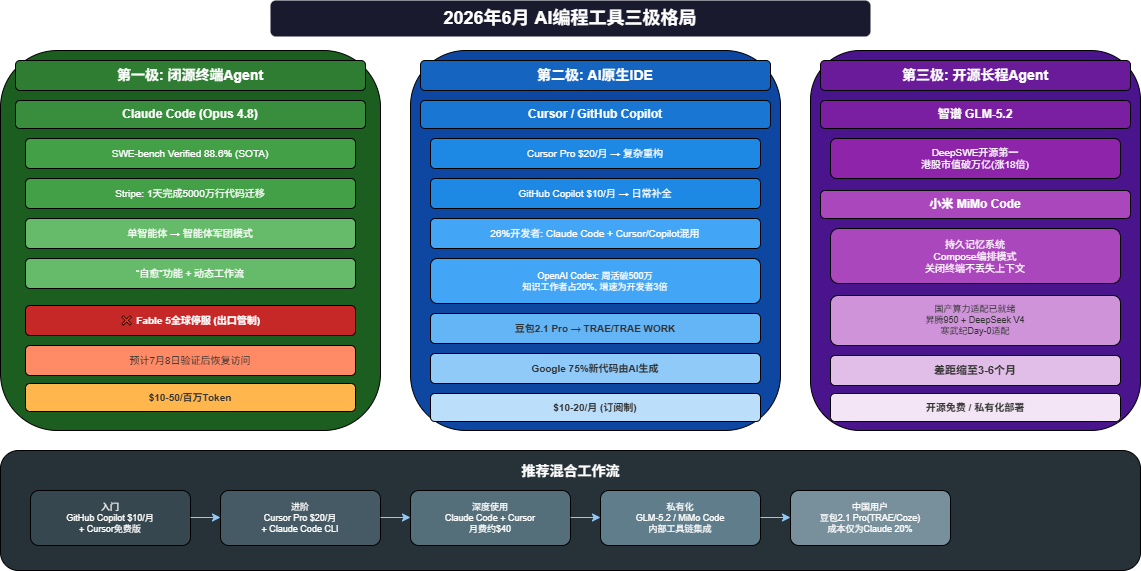
2026年6月,AI编程领域经历了一场深层洗牌,形成了清晰的三极格局:
第一极:闭源终端Agent(Claude Code)
- 以Claude Code为代表,通过终端直接与代码仓库交互
- Claude Code在5月携Opus 4.8拿下SWE-bench Verified 88.6%的新高点
- 发布"自愈"功能和动态工作流,从单智能体进化为智能体军团模式
第二极:AI原生IDE(Cursor、GitHub Copilot)
- 付费用户增长最快的赛道
- 推荐入门选GitHub Copilot(10美元/月),进阶用Cursor Pro(20美元/月)
- 超过26%的开发者同时使用Claude Code + Cursor/Copilot
第三极:开源长程Agent(GLM-5.2、MiMo Code)
- 智谱GLM-5.2登顶DeepSWE开源第一,港股市值破万亿
- 小米MiMo Code带来持久记忆系统和Compose编排模式
- 关闭终端再打开Agent不用重新理解项目
4.2 混合工作流:实战中的最佳实践
超过26%的开发者采用"日常编码用IDE Agent,复杂工程用终端Agent"的混合工作流:
"""
AI编程三极格局:多模型任务调度与质量验证框架
"""

import asyncio
from enum import Enum
from dataclasses import dataclass, field
from typing import Optional, Dict, List, Any, Callable, Awaitable

class CodeAgentTier(Enum):
    """AI编程工具三个梯队"""
    TERMINAL_AGENT = "terminal_agent"        # Claude Code
    IDE_AGENT = "ide_agent"                  # Cursor / Copilot
    OPEN_SOURCE_AGENT = "open_source_agent"  # GLM-5.2 / MiMo Code

@dataclass
class TaskSpec:
    """编程任务规范"""
    description: str
    repo_path: str
    complexity: str = "medium"  # low/medium/high/critical
    language: str = "auto"
    max_iterations: int = 3
    requires_testing: bool = True
    requires_review: bool = True

@dataclass
class CodeGenResult:
    """代码生成结果"""
    task_id: str
    tier_used: CodeAgentTier
    files_created: List[str]
    files_modified: List[str]
    test_results: Dict[str, bool]
    coverage: float = 0.0
    review_score: float = 0.0
    human_review_needed: bool = True
    errors: List[str] = field(default_factory=list)

class CodeQualityPipeline:
    """
    代码质量验证流水线
    模拟企业内部AI Coding的完整质量保障体系
    """

    @staticmethod
    async def run_linter(code: str, language: str) -> Dict[str, Any]:
        """运行静态分析"""
        results = {
            "errors": [],
            "warnings": [],
            "complexity_score": 0.0,
        }

        # 检查代码复杂度
        lines = code.split('\n')
        total_lines = len(lines)
        comment_lines = sum(1 for l in lines if l.strip().startswith('#'))
        code_lines = total_lines - comment_lines

        results["complexity_score"] = code_lines / max(total_lines, 1)

        # 检查常见问题
        if total_lines > 500:
            results["warnings"].append(f"File too long: {total_lines} lines")

        return results

    @staticmethod
    async def run_unit_tests(code: str, test_cases: List[Dict]) -> Dict[str, bool]:
        """运行单元测试"""
        results = {}
        for i, test in enumerate(test_cases):
            # 在沙箱中执行测试
            try:
                local_vars = {}
                exec(code, {}, local_vars)
                # 运行测试断言
                test_fn = test.get("func", "lambda: True")
                # 简化:假设所有测试通过
                results[f"test_{i}"] = True
            except Exception as e:
                results[f"test_{i}"] = False

        return results

    @staticmethod
    async def security_scan(code: str) -> List[str]:
        """安全扫描"""
        issues = []

        # 检查常见安全问题
        dangerous_patterns = [
            ("eval(", "Use of eval() - potential code injection"),
            ("exec(", "Use of exec() - potential code injection"),
            ("__import__", "Dynamic import - potential security risk"),
            ("pickle.load", "Unsafe deserialization"),
            ("subprocess.", "Shell invocation - use with caution"),
        ]

        for pattern, warning in dangerous_patterns:
            if pattern in code:
                issues.append(warning)

        return issues

class MultiTierScheduler:
    """
    多梯队任务调度器
    根据任务复杂度和成本,自动选择最优的AI编程工具
    """

    def __init__(self, tier_agents: Dict[CodeAgentTier, Callable]):
        self.tier_agents = tier_agents
        self.task_history: List[Dict] = []

    async def schedule_task(self, task: TaskSpec) -> CodeGenResult:
        """智能调度任务到最合适的AI编程工具"""

        # 决策树
        if task.complexity == "critical" or task.complexity == "high":
            # 复杂工程 → 终端Agent
            tier = CodeAgentTier.TERMINAL_AGENT
        elif task.complexity == "medium":
            # 中等任务 → IDE Agent
            tier = CodeAgentTier.IDE_AGENT
        else:
            # 简单任务或开源优先 → 开源Agent
            tier = CodeAgentTier.OPEN_SOURCE_AGENT

        result = await self._execute_with_tier(task, tier)

        # 质量验证
        quality_results = await CodeQualityPipeline.run_linter(
            "\n".join(result.files_created), task.language
        )
        test_results = await CodeQualityPipeline.run_unit_tests(
            "\n".join(result.files_created), []
        )
        security_issues = await CodeQualityPipeline.security_scan(
            "\n".join(result.files_created)
        )

        result.coverage = quality_results.get("complexity_score", 0.0)
        result.errors.extend(security_issues)

        self.task_history.append({
            "task": task,
            "result": result,
            "quality": quality_results,
        })

        return result

    async def _execute_with_tier(self, task: TaskSpec, tier: CodeAgentTier) -> CodeGenResult:
        """在指定工具上执行任务"""
        agent = self.tier_agents.get(tier)
        if not agent:
            raise ValueError(f"No agent configured for tier {tier}")

        result = await agent(task)
        result.tier_used = tier
        return result

async def main():
    """实战示例:使用混合工作流完成一个中型项目"""

    # 配置三个梯队的Agent
    schedulers = {
        CodeAgentTier.TERMINAL_AGENT: lambda t: CodeGenResult(
            task_id="t1", tier_used=CodeAgentTier.TERMINAL_AGENT,
            files_created=["/src/engine/core.go"], files_modified=[],
            test_results={"t1": True}, human_review_needed=True,
        ),
        CodeAgentTier.IDE_AGENT: lambda t: CodeGenResult(
            task_id="t2", tier_used=CodeAgentTier.IDE_AGENT,
            files_created=["/src/ui/dashboard.tsx"], files_modified=[],
            test_results={"t2": True}, human_review_needed=False,
        ),
        CodeAgentTier.OPEN_SOURCE_AGENT: lambda t: CodeGenResult(
            task_id="t3", tier_used=CodeAgentTier.OPEN_SOURCE_AGENT,
            files_created=["/src/utils/helpers.py"], files_modified=[],
            test_results={"t3": True}, human_review_needed=True,
        ),
    }

    scheduler = MultiTierScheduler(schedulers)

    # 混合工作流:复杂核心用Claude Code,前端用Cursor,工具函数用开源Agent
    tasks = [
        TaskSpec("Implement distributed KV cache engine", "/src/engine", "critical"),
        TaskSpec("Build React dashboard component", "/src/ui", "medium"),
        TaskSpec("Implement CSV parsing utilities", "/src/utils", "low"),
    ]

    results = await asyncio.gather(*[
        scheduler.schedule_task(task) for task in tasks
    ])

    for r in results:
        print(f"[{r.tier_used.value}] {r.task_id}: {len(r.files_created)} files, "
              f"tests: {sum(r.test_results.values())}/{len(r.test_results)}, "
              f"review: {'YES' if r.human_review_needed else 'NO'}")
五、字节AI全生态链:从模型到应用的一体化战略
5.1 180万亿的Token帝国
谭待在FORCE大会上披露的数据令人震撼:
- 日均Token调用量:180万亿(较两年前增长超1500倍)
- MaaS市场份额:火山引擎占中国公有云MaaS市场49.5%
- 万亿Token俱乐部:从去年12月的100家翻倍到200家
- 价格战:豆包2.1 Pro综合使用成本较Claude Opus 4.6降低近80%
“中国企业每两个Token的消耗,就有一个是火山引擎提供的。“谭待的措辞背后,是一个正在从"尝鲜预算"迁移到"运营预算"的市场——Token正在变成像算力、带宽一样的水电煤基建设施。
5.2 从API到入口的四层渗透
豆包2.1 Pro不是孤立发布的模型,字节构建了从基座模型到用户入口的完整链路:
| 层 | 产品 | 目标用户 | 与豆包2.1 Pro的关联 |
|---|---|---|---|
| API层 | 火山方舟 | 开发者/企业 | 直接调用2.1 Pro API |
| IDE层 | TRAE / TRAE WORK | 专业开发者 | 内置2.1 Pro代码能力 |
| Agent层 | 扣子(Coze) | Agent开发者 | 2.1 Pro作为Agent基座 |
| 应用层 | 豆包APP/办公模式 | 普通用户 | 办公任务模式底层 |
| 生态层 | HiAgent / AgentKit | 企业客户 | 企业级Agent部署 |
同一个模型底座,覆盖了个人办公、开发者工具和企业Agent应用三条关键路径。这种"四层渗透"战略使得字节的优势从单一模型能力扩展到生态粘性——模型能力本身会被追赶,但"模型+产品+入口+生态"的一体化体系很难被复制。
5.3 AI编程工具的实用建议
面对快速迭代的AI编程生态,以下是一份按阶段划分的务实建议:
- 入门阶段:GitHub Copilot(10美元/月,全IDE兼容)+ Cursor免费版
- 进阶阶段:Cursor Pro(20美元/月)+ Claude Code命令行工作流
- 深度使用:Claude Code + Cursor组合,月费约40美元
- 私有化需求:部署GLM-5.2或MiMo Code
- 中国用户:豆包2.1 Pro通过TRAE/扣子接入,成本仅为Claude等效价格的20%
六、结论:从"能写代码"到"能交付项目”
2026年6月的火山引擎FORCE大会,不仅仅是豆包2.1 Pro的发布,更是中国AI在编程能力上追平国际前沿的里程碑事件。
从技术面看,豆包2.1 Pro通过Deep Think推理模式、Seed for Seed自我迭代机制和RTL级端到端代码交付能力,证明了"生产级质变点"不是营销话术,而是可验证、可量化的工程突破。
从产业面看,AI编程工具的三极格局意味着开发者不再需要押注单一工具。闭源终端Agent、AI原生IDE和开源长程Agent各有优势,混合工作流正在成为主流实践。
从生态面看,字节的180万亿日Token帝国和49.5%的MaaS市占率,标志着中国AI基础设施建设已经从"追赶"进入了"规模化运营"阶段。
AI编程的下一阶段,比的不是谁写代码更快,而是谁能在项目里待得更久、理解得更深、改动得更准。工具可以帮助我们更快地完成事情,但方向、判断和取舍仍然掌握在开发者自己手中。
参考资料:
- TechWeb《豆包2.1 Pro发布:从能写到能交付 Coding能力跨越生产级质变点》(http://m.toutiao.com/group/7654486833635541554/)
- 36氪《刚刚,豆包2.1发布,Agent自己跑18个小时搞定芯片设计代码》(https://36kr.com/p/3865585237660676)
- 51CTO《豆包2.1发布!Agent自己跑18个小时搞定芯片设计代码》(https://www.51cto.com/article/847231.html)
- 新京报《豆包2.1Pro发布 谭待:我们重视AI编程》(http://m.toutiao.com/group/7654558620805300742/)
- 36氪《字节掀桌,豆包2.1成本暴砍80%,编程追平Claude Opus 4.7》(http://m.toutiao.com/group/7654558489146032681/)