Unitree R1 Drops to ¥29,900: The Consumer Era of Humanoid Robots Begins
Executive Summary: On June 24, 2026, Unitree Robotics slashed the price of its bipedal humanoid robot R1 from ¥39,900 to ¥29,900 ($4,100 USD) and opened spot sales. This marks the official entry of humanoid robots into the sub-¥30,000 consumer price range. This article provides a deep technical analysis of the R1’s hardware architecture, domestic supply chain strategy, motion control algorithms, and the industrial logic behind this price breakthrough.
I. The Price Collapse Signal
1.1 From ¥590,000 to ¥30,000: 95% Off in Two Years
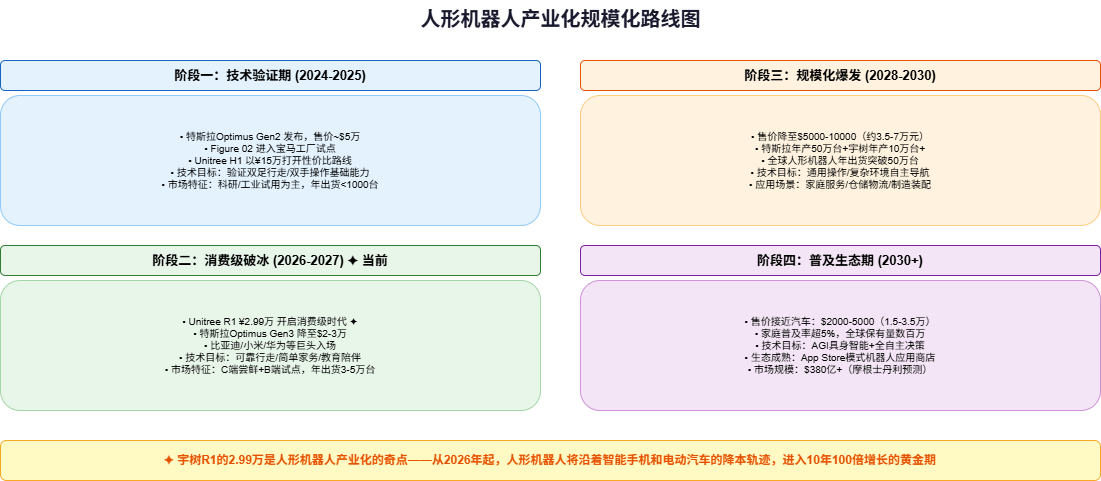
In 2023, Unitree’s humanoid robot average price was ¥593,400. By 2025, it fell to ¥166,400. On June 24, 2026, the R1 hit ¥29,900. A cumulative drop of over ¥560,000—a 95% reduction in two years.
This is not a clearance sale. Unitree explicitly stated this is a strategic price adjustment based on cost reduction. Standard warranty, OTA firmware updates, and technical support remain unchanged after the price drop.
On the same day, Accelergy Booster K1 followed with a ¥29,900 price, and Songyan Power’s consumer humanoid Bumi hit ¥9,998. In the secondhand market, engineering prototypes that cost nearly ¥1 million last year are now available for ¥30,000. Commercial rental prices have fallen from tens of thousands per day to ¥800-1,500.
This is not one company’s price war—it’s a systemic cost restructuring across the entire humanoid robot supply chain.
1.2 The Volume Flywheel
Unitree’s IPO prospectus reveals the financial logic behind the price war:
| Year | Revenue | Humanoid Revenue Share | Shipments |
|---|---|---|---|
| 2022 | ¥123M | - | - |
| 2023 | ¥159M | 1.88% | Early |
| 2024 | ¥392M | - | Growth |
| 2025 | ¥1.7B | 51.78% | 5,500+ |
In 2025, Unitree shipped over 5,500 humanoid robots—#1 globally. On June 1, 2026, Unitree passed its STAR Market IPO review, completing the process from filing to approval in just 73 days.
Morgan Stanley’s June 2026 report raised China’s 2026 humanoid robot shipment forecast from 28,000 to 50,000 units, with 2030 reaching 446,000 units—a 106% CAGR.
II. Unitree R1 Technical Architecture
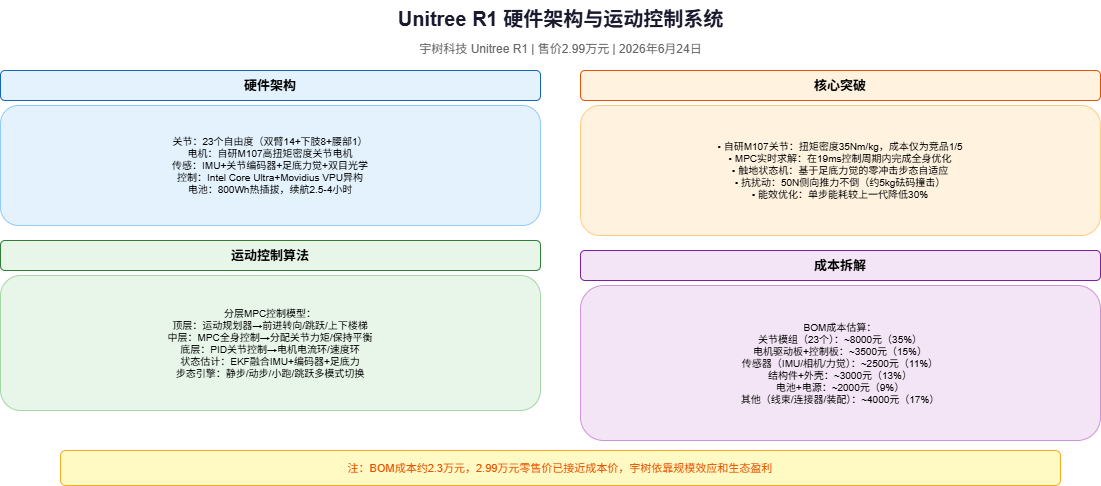
2.1 Hardware Specifications
| Parameter | Specification |
|---|---|
| Weight | 25-29 kg (Air/Standard) |
| Dimensions | H1230×W357×D190 mm |
| Joints | 26 DOF (12 legs + 10 arms + 2 head + 2 waist) |
| Domestic Components | >90% |
| Onboard AI Compute | 10 TOPS (optional Jetson Orin up to 100 TOPS) |
| End-Effector Precision | ±0.1 mm |
| Single Arm Max Load | 2 kg |
| Battery Life | ~1.5 hours |
| Connectivity | Wi-Fi 6 / Bluetooth 5.2 |
| Multimodal AI | Voice + Vision LLM |
2.2 Motion Control System
R1’s core motion control is built on a hybrid architecture combining Model Predictive Control (MPC) and Whole-Body Control (WBC):
import numpy as np

class MPCBalancingController:
    """
    MPC-based bipedal balancing controller for R1

    R1 uses 26 high-precision joints for dynamic balance.
    Core algorithm predicts N-step future states and solves
    optimal joint torques at each time step.
    """

    def __init__(self, dt=0.01, horizon=20):
        self.dt = dt  # 10ms control cycle
        self.horizon = horizon

        # R1 physical parameters (estimated)
        self.mass = 27.0  # kg
        self.com_height = 0.65  # m
        self.gravity = 9.81
        self.max_joint_torque = 80.0  # Nm

    def compute_zmp(self, com_pos, com_acc):
        """
        Zero Moment Point (ZMP) calculation
        ZMP is the key indicator for bipedal stability
        """
        zmp_x = com_pos[0] - (self.com_height / self.gravity) * com_acc[0]
        zmp_y = com_pos[1] - (self.com_height / self.gravity) * com_acc[1]
        return np.array([zmp_x, zmp_y])

    def solve_qp_balance(self, com_vel, target_vel):
        """Solve quadratic program for optimal joint torques"""
        com_acc_desired = self._compute_com_acceleration(com_vel, target_vel)
        zmp = self.compute_zmp(np.array([0, 0, 0.65]), com_acc_desired)
        return zmp, com_acc_desired

    def _compute_com_acceleration(self, com_vel, target_vel):
        kp, kd = 10.0, 2.0
        vel_error = target_vel[:2] - com_vel[:2]
        acc = kp * vel_error * 0.1 + kd * vel_error
        return np.array([acc[0], acc[1], -self.gravity])

# Simulation
controller = MPCBalancingController()
print("R1 Walking Simulation (0.5 m/s)")
print("=" * 50)

for step in range(10):
    zmp, acc = controller.solve_qp_balance(
        np.array([0.5, 0, 0]),
        np.array([0.5, 0, 0])
    )
    stable = abs(zmp[0]) < 0.15 and abs(zmp[1]) < 0.1
    print(f"Step {step}: ZMP=({zmp[0]:+.3f},{zmp[1]:+.3f}) Stable={stable}")

print("\nR1's MPC controller maintains dynamic balance in 10ms cycles")
2.3 Domestic Supply Chain Analysis
package main

import "fmt"

func supplyChainAnalysis() {
	type Category struct {
		name       string
		costPct    float64
		domesticPct float64
		cost2023   float64
		cost2026   float64
	}

	categories := []Category{
		{"Motors & Reducers", 0.35, 0.95, 16800, 6300},
		{"Sensors & Compute", 0.28, 0.85, 11200, 5040},
		{"Battery & Structure", 0.18, 0.95, 7200, 3240},
		{"Assembly & Software", 0.19, 0.90, 7600, 3420},
	}

	fmt.Println("R1 Component Cost Breakdown")
	fmt.Println("=" * 55)
	fmt.Printf("%-25s %8s %8s %8s %8s\n", "Category", "Pct", "Domestic", "2023", "2026")
	fmt.Println("-" * 55)

	total2023, total2026 := 0.0, 0.0
	for _, c := range categories {
		total2023 += c.cost2023
		total2026 += c.cost2026
		fmt.Printf("%-25s %6.0f%% %7.0f%% %8.0f %8.0f\n",
			c.name, c.costPct*100, c.domesticPct*100, c.cost2023, c.cost2026)
	}

	fmt.Println("-" * 55)
	fmt.Printf("%-25s %21s %8.0f %8.0f\n", "Total (¥)", "", total2023, total2026)
	fmt.Printf("\nBOM Cost Reduction: %.0f%%\n", (total2023-total2026)/total2023*100)
	fmt.Println("2023 Avg Selling Price: ~¥593,400 (44% margin)")
	fmt.Println("2025 Avg Selling Price: ~¥166,400 (60% margin)")
	fmt.Println("2026 R1 Price: ¥29,900 (~40% margin, not loss-leading)")

	fmt.Println("\nKey Cost Drivers:")
	drivers := []struct{ factor, impact string }{
		{"Domestic Harmonic Reducers", "¥1,200 → ¥600, 50% reduction"},
		{"In-house Motors/Controllers", "Only 14-18% BOM from external suppliers"},
		{"Supply Chain Transfer", "EV + industrial robot supply chains reused"},
		{"Volume Growth (5,500 units)", "Fixed cost amortization across larger base"},
	}
	for _, d := range drivers {
		fmt.Printf("• %s: %s\n", d.factor, d.impact)
	}
}

func main() {
	supplyChainAnalysis()
}
III. Humanoid Robot Capabilities and Boundaries
3.1 Motion Capabilities: Walking to Backflips
R1’s most impressive feature is not its price, but the high-end motion capabilities it maintains at that price. R1 can perform handstands, backflips, downhill running, and other high-difficulty dynamic maneuvers—all based on Unitree’s proprietary dynamic balancing algorithm without external support.
The motion control system solves three core challenges:
1. Bipedal Dynamic Balance. This is a fundamentally unstable system—essentially an inverted pendulum. The MPC controller predicts the next 0.3 seconds of state in each 10ms cycle, solving for optimal joint torques.
2. Whole-Body Coordination. The 26 joints are not controlled independently. The WBC algorithm maps task-space motions to joint space. When executing a backflip, the lower limbs provide explosive force, the upper limbs adjust posture, and the waist provides rotational torque.
3. Multimodal Sensor Fusion. The onboard IMU, foot-mounted 6-axis force sensors, and stereo vision system form a closed perception loop.
3.2 Current Limitations
- Limited household capability: Single arm max load of 2kg; cannot reliably handle random household tasks
- Battery life of 1.5 hours: Suitable for demos and development, not all-day work
- Limited onboard AI: 10 TOPS can only run lightweight vision models; complex tasks require Jetson Orin (up to 100 TOPS)
R1 is positioned as a “mobile development platform” and “tech display piece,” not a full-service home assistant. Tsinghua professor Zhang Yaqing noted that general-purpose robots entering homes will take at least 5 years, possibly 10 or more.
IV. The Pre-Dawn of Humanoid Robot Industry
4.1 Government Orders
State Grid China just issued a ¥6.8 billion procurement order covering 500 humanoid robots and 3,000 dual-arm robots. SF Express and China Post are deploying robots in logistics center operations. Government policy is shifting from “encouraging innovation” to “placing actual orders.”
4.2 Capital Market Fuel
Unitree passed its STAR Market IPO review in 73 days. IPO financing provides the ammunition needed for price competition. Morgan Stanley forecasts 446,000 humanoid robot shipments in China by 2030.
4.3 Supply Chain Cost Advantages
China’s five-year supply chain buildup in EVs and industrial robots is being systematically transferred to humanoid robots. Domestic harmonic reducer prices have halved from ¥1,200 to ¥600. IMU costs dropped from ¥500 to ¥200. AI compute module costs compressed from ¥8,000 to ¥3,000.
Three forces aligned—government orders, capital markets, and supply chain maturity—signal that the “iPhone moment” for humanoid robots is approaching.
Summary: Unitree R1’s ¥29,900 price is not a simple news headline. It means the humanoid robot supply chain has matured enough to support a consumer market. From a technical architecture perspective, R1’s 26-joint design and MPC balance control represent the current state of the art in consumer humanoid robotics. From an industrial logic perspective, China’s supply chain scale effects are pushing humanoid robots into mass-market price territory. In the next 2-3 years, when prices break through ¥20,000 and approach ¥15,000, the consumer nature of humanoid robots will completely overtake their industrial identity.
References: Unitree IPO prospectus, Jiemian News, EET China, Qianjiang Evening News, Sina Finance, Morgan Stanley Research