NVIDIA Shareholder Meeting Deep Dive: Vera Rubin in Full Production, AI Factory Era, Huang Declares "Useful AI Has Arrived and It's Profitable"
Executive Summary: On June 24, 2026, NVIDIA’s annual shareholder meeting delivered multiple blockbuster signals. CEO Jensen Huang announced the Vera Rubin architecture has entered full production, positioning it as “the world’s first CPU built for AI agents.” He introduced the “AI Factory” paradigm—where every token is a unit of profit—and declared unequivocally that “useful AI has arrived and it’s already profitable.” The most striking data point: GitHub code merge velocity has nearly tripled in the first months of 2026, with 30 million developers producing nearly $9 trillion in economic output with AI assistance. Physical AI was defined as the next growth wave.
I. Core Signals: Confirmation of the AI Supercycle
1.1 “Useful AI Has Arrived, and It’s Profitable”
Jensen Huang’s opening statement at the shareholder meeting directly addressed the market’s central anxiety over the past six months—the AI ROI question. His answer was unequivocal:
“Useful AI has arrived, and it’s already profitable.”
This wasn’t mere rhetorical positioning. The numbers back it up. NVIDIA’s FY2026 revenue grew 65% to $216 billion, data center revenue grew 68% to $194 billion, and operating cash flow reached $103 billion. International market revenue grew over 3x to $30 billion, and nearly 40 countries and regions representing $50 trillion in combined GDP are deploying NVIDIA AI infrastructure.
Huang’s core formulation: AI factories manufacture tokens, and every token is a unit of profit.
“Traditional data centers store files and serve them. AI factories manufacture tokens. Tokens become code, answers, designs, actions, and services.” Huang summarized this logic: more compute capacity → more tokens → more revenue. Thus infrastructure buildout “will be measured in decades.”
The most compelling evidence came from GitHub data. Approximately 30 million software developers worldwide earn roughly $3 trillion in annual compensation, supporting approximately $100 trillion in economic activity. In 2023, developers merged 300 million PRs; in 2024, 400 million; in 2025, 500 million—steady growth. But in the first few months of 2026, that velocity nearly tripled.
“With AI agents, the same workforce is now producing close to $9 trillion in output—an additional $6 trillion.” That $6 trillion figure represents the productivity dividend AI has already delivered.
The chain of reasoning is powerful enough: AI creates measurable economic value → tokens have value → tokens generate profit → compute demand accelerates → NVIDIA’s infrastructure enters a positive flywheel. This is not a “burn money on speculation” story; it’s a “ROI is already proven” business model.
1.2 Customer Base Transformation: From Cloud to Traditional Industry
Huang specifically noted that NVIDIA’s customer base is undergoing a qualitative transformation. Beyond hyperscale cloud providers and AI labs, traditional industry giants—Capital One (finance), Hyundai (manufacturing), Jane Street (quantitative trading), and Eli Lilly (pharmaceuticals)—are deploying NVIDIA infrastructure at scale.
This signals that AI infrastructure investment has moved from “experimental exploration” into “production deployment.” Finance uses AI for risk management and quantitative trading, manufacturing for smart factories, and pharmaceuticals for drug discovery—every industry is racing to adopt agentic AI.
Huang described the AI industry’s complete structure as a “five-layer cake”:
- Energy Layer: Power supply
- Chip & System Layer: GPU/CPU/Network/Storage
- Infrastructure Layer: Data centers/AI factories
- Model Layer: LLMs/Multimodal models
- Application Layer: Agents/Enterprise applications
NVIDIA’s business spans Layers 2 through 3 and is penetrating Layer 1 (energy) through system-level power optimization.
II. Vera Rubin: Architecture Built for Agents
2.1 Three Generations of Chips, Three Strategic Positions
Huang clearly articulated the differentiated positioning of NVIDIA’s three chip generations—a strategic narrative worth careful examination:
| Architecture | Positioning | Core Mission |
|---|---|---|
| Hopper (H100) | Built for pre-training | Enable LLMs from 0 to 1 |
| Blackwell (B200) | Inference at rack scale | Production deployment of LLM inference |
| Vera Rubin | Built for agents | CPU+GPU synergy for real-time agent interaction |
Why does Vera Rubin matter? Huang’s answer cut to the heart: “Agents live in a nanosecond-scale computational world.”
2.2 Vera CPU: The Most Underestimated Strategic Product
Huang called Vera CPU “one of the most important product launches in NVIDIA’s history.” This statement deserves serious consideration—NVIDIA has previously launched CUDA, Tensor Core, NVLink, and other revolutionary products.
Vera CPU’s strategic logic unfolds as follows:
The limitation of traditional CPUs. All previous CPUs were designed for humans—sliced into cores rented as units, optimized for multi-core parallel processing. But agents have fundamentally different CPU requirements. Agents execute a continuous loop: “think → call a tool → access a database → execute code → verify results.” Every step in this loop requires CPU intervention.
CPU bottleneck = GPU idle = revenue loss. If the CPU isn’t fast enough, the GPU must wait. In an AI factory, the GPU is the highest-value asset—each B200 costs approximately $45,000. Idle GPU time means declining capital returns. Vera CPU is designed as “the fastest CPU for agent responsiveness,” eliminating this bottleneck.
A new market of billions of agents. “There will be billions of agents in the future, and they need CPUs built specifically for them.” Huang positioned Vera CPU as the strategic entry point into an entirely new market—the agent CPU market. NVIDIA EVP and CFO Colette Kress previously disclosed that the company expects CPU revenue to approach $20 billion in FY2027, positioning NVIDIA as a potential global leader in CPU supply.
Vera Rubin is now in full production, with major model builders, public clouds, and hyperscale customers already planning deployments. Huang noted that orders are flooding in.
2.3 Vera Rubin Performance Metrics
By integrating 7 specialized chips into 5 accelerated racks, Vera Rubin achieves, compared to Blackwell:
- Up to 35x inference throughput
- Up to 10x AI factory revenue
Blackwell itself was already recognized by SemiAnalysis’s InferenceX benchmark as the “King of Inference,” delivering 30x higher token throughput than the next-best platform. Vera Rubin increases this by another 35x—a leapfrog performance improvement.
III. Physical AI: NVIDIA’s Next Growth Wave
3.1 From Digital to Physical Worlds
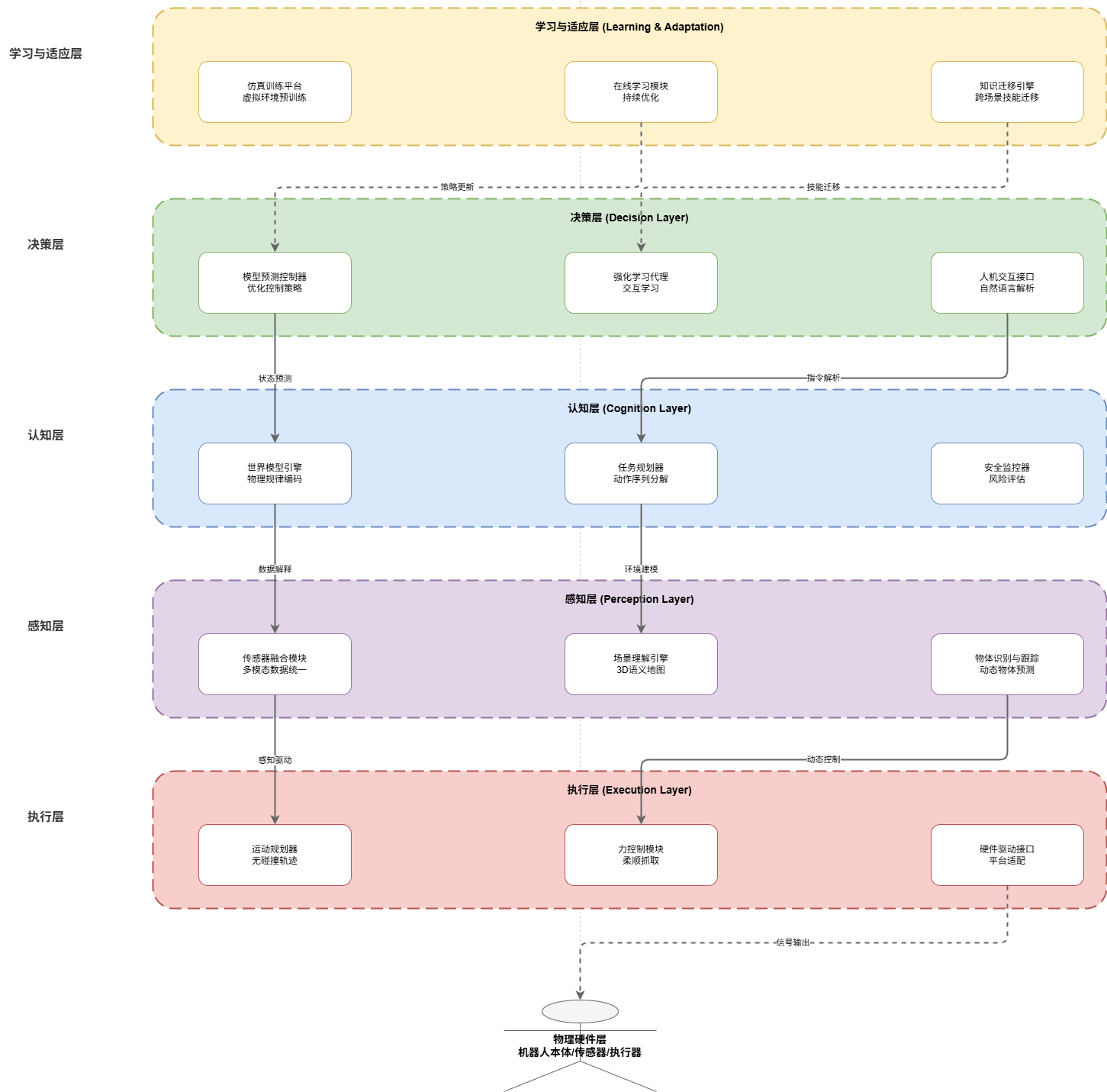
If the three preceding chip generations (Hopper/Blackwell/Vera Rubin) solved the “digital world reasoning problem,” Physical AI targets the “physical world autonomous decision-making problem.”
Huang defined Physical AI as “the next wave of growth.” He argued that robots, cars, and factories will become agents in the physical world—capable of sensing, reasoning, planning, and acting autonomously.
NVIDIA has built a complete closed-loop system for Physical AI:
AI Factory (Model Training)
    ↓
Omniverse (Virtual Simulation & Validation)
    ↓
Jetson (Edge Hardware Deployment)
    ↓
Physical World (Robots/Cars/Factories Operating Autonomously)
    ↓
Data Feedback Loop (Real-world data improving models)
3.2 Three Platforms Forming a Closed Loop
NVIDIA’s Physical AI deployment involves three platforms:
1. AI Factory — Model Training Platform
Physical AI models must understand the laws of physics—gravity, collision, material properties, lighting, acoustics, etc. These models are trained in AI factories using massive real-world and synthetic datasets.
The newly announced BioNeMo suite marks a significant milestone in CUDA’s evolution from “tools for human developers” to “toolkits for agents.” BioNeMo is specifically designed for digital biology and drug discovery agents—the first major product in the CUDA X library ecosystem’s migration toward agentic scenarios.
2. Omniverse — Simulation & Validation Platform
Physical AI models cannot “trial-and-error” in the real world—deploying untested autonomous driving models on public roads is dangerous. Omniverse provides a high-fidelity physics simulation environment where AI models can complete millions of “test drives” in virtual worlds before deployment to physical devices.
Omniverse’s importance cannot be overstated. It is essentially the “safe training ground” for Physical AI and a critical node in the data flywheel—data generated in virtual worlds flows back into training sets, continuously improving models.
3. Jetson — Edge Deployment Platform
Trained models run on robots and devices via Jetson and other edge computing platforms. Jetson provides efficient inference capabilities in low-latency, low-power environments, ensuring Physical AI models run effectively at the edge.
3.3 Physical AI Market Impact
The Physical AI market dwarfs pure digital AI. Digital AI processes code, text, images, and audio—digital information. Physical AI processes the full complexity of the physical world. The total GDP of global manufacturing, logistics, construction, agriculture, and healthcare far exceeds the digital sector.
def physical_ai_market_analysis():
    """
    Physical AI Market Size Analysis
    """

    sectors = {
        "Autonomous Driving": {
            "current_market_t": 800,
            "ai_penetration_2026": 0.15,
            "ai_value_2028": 1200,
            "key_players": "Tesla, Waymo, Baidu Apollo",
            "description": "L4 autonomous driving in limited commercial areas"
        },
        "Smart Manufacturing": {
            "current_market_t": 3500,
            "ai_penetration_2026": 0.08,
            "ai_value_2028": 2000,
            "key_players": "Siemens, GE, Fanuc",
            "description": "AI-driven flexible manufacturing & quality control"
        },
        "Warehousing & Logistics": {
            "current_market_t": 1500,
            "ai_penetration_2026": 0.12,
            "ai_value_2028": 800,
            "key_players": "Amazon Robotics, Geek+",
            "description": "Autonomous mobile robots & intelligent sorting"
        },
        "Medical Surgery": {
            "current_market_t": 600,
            "ai_penetration_2026": 0.05,
            "ai_value_2028": 400,
            "key_players": "Intuitive Surgical, MicroPort",
            "description": "AI-assisted surgical robots & diagnostics"
        },
        "Construction": {
            "current_market_t": 12000,
            "ai_penetration_2026": 0.02,
            "ai_value_2028": 600,
            "key_players": "Built Robotics, Country Garden Bozhilin",
            "description": "Automated construction & BIM"
        },
        "Agricultural Automation": {
            "current_market_t": 3500,
            "ai_penetration_2026": 0.03,
            "ai_value_2028": 300,
            "key_players": "John Deere, XAG",
            "description": "Autonomous farming & precision agriculture"
        }
    }

    print("=" * 90)
    print("Physical AI Industry Application Outlook")
    print("=" * 90)
    print(f"{'Sector':<22} {'Current Mkt($B)':<18} {'AI Penetration':<16} {'2028 AI Value($B)':<18} {'Key Players':<30}")
    print("-" * 90)

    total_ai_value_2028 = 0
    for sector, data in sectors.items():
        total_ai_value_2028 += data["ai_value_2028"]
        print(f"{sector:<22} ${data['current_market_t']:<8}B  {data['ai_penetration_2026']*100:<5.0f}%  "
              f"${data['ai_value_2028']:<6}B            {data['key_players']:<30}")

    print("-" * 90)
    print(f"{'Total':<22} {'':18} {'':16} ${total_ai_value_2028:<10}B")

    # Comparison with digital AI
    digital_ai_2028 = 5000
    ratio = total_ai_value_2028 / digital_ai_2028

    print(f"\nComparative Analysis:")
    print(f"  Digital AI Market (2028E): ~${digital_ai_2028}B")
    print(f"  Physical AI Market (2028E): ~${total_ai_value_2028}B")
    print(f"  Physical/Digital AI Ratio: {ratio:.1f}x")
    print(f"  Physical AI will match digital AI market size by 2028")
    print(f"  But Physical AI has a higher long-term ceiling—covering the full")
    print(f"  output of the global real economy")

if __name__ == "__main__":
    physical_ai_market_analysis()
IV. CUDA Ecosystem: Agentic Evolution
4.1 The Crown Jewel Evolves
Huang called the CUDA X library ecosystem NVIDIA’s “crown jewel”—“one of the most important strategic investments in the company’s history and a moat competitors find difficult to cross.”
CUDA currently supports over 7,000 applications, generating a powerful flywheel effect: a unified architecture with a massive installed base attracts developers, developers create breakthrough applications, applications open new markets, and new markets expand the installed base.
As the agentic era arrives, the CUDA X libraries are undergoing a deep evolution—from toolsets for human developers to toolkits for AI agents. The launch of BioNeMo marks a milestone in this transformation.
4.2 CUDA Flywheel Effect in Go
package main

import (
	"fmt"
	"sync"
)

// CUDAMoatSimulator simulates CUDA ecosystem flywheel and moat dynamics
type CUDAMoatSimulator struct {
	totalDevelopers   int
	applicationsCount int
	installBase       int64
	networkEffect     float64
	mu                sync.RWMutex
}

type FlywheelMetrics struct {
	Year              int
	Developers        int
	Applications      int
	InstallBase       int64
	NewMarketsOpened  int
	MoatDepth         float64
	CompetitorCatchUp float64
}

func (c *CUDAMoatSimulator) SimulateFlywheel(years int) []FlywheelMetrics {
	metrics := make([]FlywheelMetrics, years)

	for y := 0; y < years; y++ {
		c.mu.Lock()

		// Core flywheel formula:
		// Install base → attract developers → build apps → open markets → expand install base

		if y > 0 {
			appGrowthRate := float64(c.applicationsCount) / float64(c.applicationsCount+1000)
			growthFactor := 1.0 + appGrowthRate*c.networkEffect*0.1
			c.installBase = int64(float64(c.installBase) * growthFactor)
		}

		if y > 0 {
			devGrowthRate := 0.05 + c.networkEffect*0.02
			c.totalDevelopers = int(float64(c.totalDevelopers) * (1.0 + devGrowthRate))
		}

		if y > 0 {
			newAppsPerDev := float64(c.totalDevelopers) * 0.001 * c.networkEffect
			c.applicationsCount += int(newAppsPerDev)
		}

		newMarkets := 1
		if y >= 3 {
			newMarkets = 2
		}
		if y >= 6 {
			newMarkets = 3
		}

		ecosystemMaturity := float64(c.applicationsCount) / 10000.0
		if ecosystemMaturity > 1.0 {
			ecosystemMaturity = 1.0
		}
		moatDepth := ecosystemMaturity * float64(c.installBase) / 1e7 * c.networkEffect

		competitorTime := ecosystemMaturity * float64(c.installBase) / 5e6
		if competitorTime < 3.0 {
			competitorTime = 3.0
		}

		metrics[y] = FlywheelMetrics{
			Year:              2026 + y,
			Developers:        c.totalDevelopers,
			Applications:      c.applicationsCount,
			InstallBase:       c.installBase,
			NewMarketsOpened:  newMarkets,
			MoatDepth:         moatDepth,
			CompetitorCatchUp: competitorTime,
		}
		c.mu.Unlock()
	}
	return metrics
}

func main() {
	fmt.Println("NVIDIA CUDA Ecosystem Flywheel Simulation")
	fmt.Println("=" * 50)

	simulator := &CUDAMoatSimulator{
		totalDevelopers:   7000000,
		applicationsCount: 7000,
		installBase:       50000000,
		networkEffect:     0.85,
	}

	metrics := simulator.SimulateFlywheel(5)

	fmt.Printf("\n%5s %12s %12s %14s %10s %12s %14s\n",
		"Year", "Devs", "Apps", "InstallBase", "Markets", "Moat", "CatchUp")
	fmt.Println("-" * 80)

	for _, m := range metrics {
		fmt.Printf("%5d %10d %10d %12d %8d %10.1f %12.1fyr\n",
			m.Year, m.Developers, m.Applications,
			m.InstallBase, m.NewMarketsOpened,
			m.MoatDepth, m.CompetitorCatchUp)
	}

	fmt.Println("\nVerbatim: CUDA's moat deepens as ecosystem expands exponentially")
	fmt.Println("Competitors (AMD ROCm/Intel oneAPI) face increasing catch-up time")

	// Inference efficiency analysis
	fmt.Println("\n\nBlackwell 'King of Inference' Performance Analysis:")
	fmt.Println("-" * 50)
	throughputComparison := map[string]float64{
		"NVIDIA Blackwell B200": 30.0,
		"NVIDIA H100 SXM":       1.0,
		"Google TPU v6":         2.5,
		"AMD MI350X":            1.8,
		"Groq LPU":              3.5,
		"Cerebras CS-3":         4.2,
	}

	for chip, tp := range throughputComparison {
		barLen := int(tp * 2)
		bar := ""
		for i := 0; i < barLen; i++ {
			bar += "█"
		}
		fmt.Printf("%-30s %5.1fx %s\n", chip, tp, bar)
	}
}
V. China Factor and Supply Chain Risks
5.1 H200 Export Approved but Zero Revenue
On China-related business, Huang offered a noteworthy statement: the U.S. government has approved licenses for H200 chip exports to Chinese customers, but NVIDIA has yet to generate any related revenue, and uncertainty remains about whether products can successfully enter China.
This means H200 exports to China have received “licensing-level” approval but still face “delivery-level” obstacles. Huang made no projections about the scale of NVIDIA’s China business and did not mention any specific customers.
5.2 Public Warning on Chip Smuggling
Huang also issued a rare public warning about chip smuggling. He stated that NVIDIA’s compliance efforts have repeatedly intercepted smuggling attempts, and those involved face dual-jurisdiction prosecution risks.
“Building a data center on smuggled chips is a dead end,” Huang stated bluntly, noting that without official software support, hardware maintenance, and after-sales service, smuggled chips cannot operate commercial AI workloads normally. This statement serves both as a warning to potential violators and as a demonstration to the U.S. government of NVIDIA’s proactive export compliance posture.
References: Cailianshe, Wall Street Insight, Yicai, Shanghai Securities News, 21st Century Business Herald, NVIDIA shareholder meeting transcript